
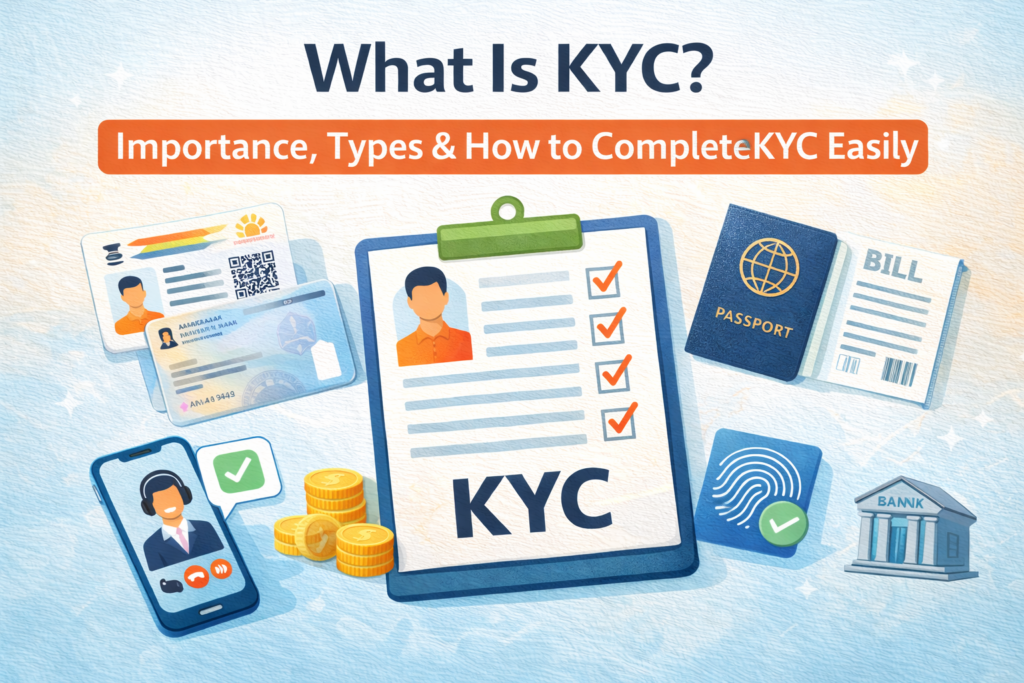
In today’s digital financial world, opening a bank account, investing in mutual funds, or applying for a loan usually requires one common step—KYC. Many people complete KYC Importance without fully understanding what it means or why it is necessary. KYC is not just a formality; it plays a vital role in protecting both customers and financial institutions.
This article explains what KYC Importance is, why it is important, the different types of KYC, and how you can complete KYC easily, both online and offline. The guide is written in simple language so that even beginners can understand it clearly.
What Is KYC?
KYC stands for Know Your Customer. It is a verification process used by banks, financial institutions, and regulated entities to confirm the identity and address of their customers.
The main purpose of KYC is to ensure that financial services are not misused for illegal activities such as fraud, money laundering, or identity theft. By verifying customer details, institutions can maintain transparency and security in the financial system. KYC Importance
KYC usually involves submitting identity proof, address proof, and sometimes a photograph or biometric verification.
Why Is KYC Important?
KYC is important for both customers and financial institutions. It ensures safety, compliance, and trust in financial transactions.
Importance of KYC for Customers
- Prevents identity theft and fraud
- Enables smooth access to banking and financial services
- Reduces chances of account misuse
- Helps in faster loan and investment approvals
Importance of KYC for Financial Institutions
- Ensures regulatory compliance
- Helps prevent money laundering and fraud
- Improves customer verification accuracy
- Builds a transparent financial ecosystem
Without KYC, financial institutions may face legal penalties and customers may experience service restrictions.
Where Is KYC Required?
KYC is mandatory for most financial activities, including:
- Opening bank accounts
- Applying for loans
- Using credit cards
- Investing in mutual funds or stocks
- Buying insurance policies
- Using digital wallets and payment apps
Failure to complete KYC can lead to account suspension or limited access to services.
Types of KYC
KYC can be completed in different ways depending on the institution and the service being used.
1. Physical KYC
Physical KYC Importance involves visiting a bank or service provider in person and submitting documents manually.
Process includes:
- Filling out a KYC form
- Submitting photocopies of documents
- In-person verification
Although reliable, physical KYC is time-consuming and less convenient.
2. e-KYC
e-KYC is an electronic verification process that uses digital records and online authentication.
Advantages of e-KYC:
- Faster process
- Paperless verification
- Can be done from home
- Secure and efficient
e-KYC is widely used by banks, fintech apps, and investment platforms.
3. Video KYC
Video KYC allows customers to complete verification through a live video call.
How it works:
- Live interaction with a representative
- Showing original documents on camera
- Face verification
Video KYC is secure and convenient, especially for remote customers.
4. Central KYC (CKYC)
CKYC is a centralized KYC system where customer data is stored securely and can be accessed by multiple institutions with consent.
Benefits of CKYC:
- One-time KYC process
- Eliminates repeated submissions
- Faster onboarding
Once registered, your CKYC number can be used across institutions.
Documents Required for KYC
The documents required for KYC usually fall into two categories.
Identity Proof
- PAN card
- Aadhaar card
- Passport
- Voter ID
Address Proof
- Aadhaar card
- Utility bills
- Bank statement
- Passport
Some institutions may require both identity and address proof separately.
How to Complete KYC Easily (Step-by-Step)
Step 1: Choose the Service Provider
Select the bank, financial app, or institution where you want to complete KYC.
Step 2: Submit Basic Details
Provide personal details such as:
- Name
- Date of birth
- Address
- Identification number
Step 3: Upload Documents
Upload clear images of required documents. Ensure the information is accurate and readable.
Step 4: Complete Verification
Depending on the method:
- OTP verification
- Video call
- In-person verification
Step 5: Confirmation
Once verified, you will receive confirmation via SMS or email.
Common KYC Mistakes to Avoid
- Submitting unclear or expired documents
- Mismatch between documents
- Incorrect personal details
- Ignoring KYC update requests
Avoiding these mistakes ensures faster approval and uninterrupted service.
How Often Should KYC Be Updated?
KYC should be updated when:
- There is a change in address
- Name or contact details change
- Documents expire
Regular updates help maintain compliance and avoid service restrictions.
Benefits of Completing KYC on Time
- Uninterrupted access to financial services
- Faster processing of transactions
- Improved account security
- Better trust with financial institutions
Timely KYC completion also prevents account freezing or transaction limits.
Is KYC Safe?
KYC processes follow strict security standards. Regulated institutions use encrypted systems to protect customer data. However, customers should: KYC Importance
- Share documents only on official platforms
- Avoid unknown links or messages
- Never share OTPs or sensitive details
Being cautious ensures data safety.
FAQs About KYC
What happens if KYC is not completed?
Accounts may face restrictions or suspension.
Can one KYC be used everywhere?
Central KYC allows reuse across multiple institutions.
Does KYC affect credit score?
No, KYC does not impact your credit score.
Is KYC mandatory for small accounts?
Some basic accounts may allow limited usage without full KYC.
Conclusion
KYC is a crucial process that ensures safety, transparency, and compliance in financial transactions. Understanding what KYC is, why it is important, and how to complete it easily helps you avoid unnecessary delays and service disruptions.
With digital options like e-KYC and video KYC, completing verification has become faster and more convenient than ever. By completing KYC on time and keeping details updated, you can enjoy seamless access to financial services with confidence.
Disclaimer
This article is for informational purposes only and does not constitute legal or financial advice. Always follow official guidelines provided by financial institutions.