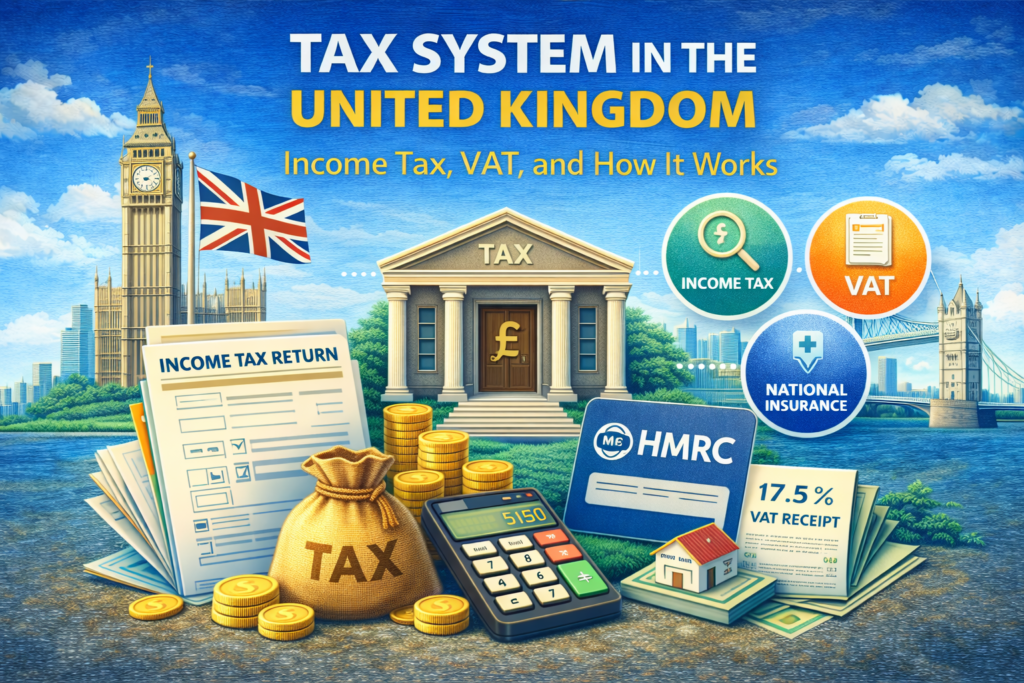
The tax system in the United Kingdom plays a central role in funding public services and maintaining economic stability. Taxes collected by the UK government support healthcare through the National Health Service (NHS), education, infrastructure, social welfare programs, public transport, and national security. For individuals and businesses living or operating in the UK, understanding how the tax system works is essential for compliance and financial planning.
The UK has a well-structured and mature tax system that includes both direct and indirect taxes. While income tax is the most familiar tax for individuals, other taxes such as National Insurance contributions, Value Added Tax (VAT), and corporation tax also contribute significantly to government revenue.
This article explains the tax system in the United Kingdom in a simple and beginner-friendly way, covering major types of taxes, how they are collected, and how tax revenue is used.
Overview of the UK Tax System
The UK tax system is managed primarily by HM Revenue and Customs (HMRC), the government department responsible for collecting taxes and enforcing tax laws.
Taxes in the UK can be broadly divided into:
- Direct taxes, paid directly by individuals or businesses
- Indirect taxes, paid on goods and services
The UK tax system aims to balance fairness, efficiency, and economic growth while ensuring sufficient revenue for public services.
Why Taxes Are Collected in the UK
- Fund healthcare services (NHS)
- Support education and universities
- Maintain roads, railways, and public transport
- Provide social benefits and pensions
- Ensure public safety and national defense
Tax revenue allows the government to provide essential services and support economic development.
Direct Taxes in the United Kingdom
Income Tax
Income tax is one of the main sources of government revenue in the UK. It is paid by individuals on their earnings.
Key Features of UK Income Tax
- Applied to salaries, wages, pensions, and some investment income
- Uses a progressive tax system
- Higher income earners pay a higher percentage of tax
- Collected annually
Most employees pay income tax automatically through the Pay As You Earn (PAYE) system. tax system in the United Kingdom
National Insurance Contributions (NICs)
National Insurance is closely linked to income tax but serves a specific purpose.
Purpose of National Insurance
- Funds state pensions
- Supports unemployment and sickness benefits
- Contributes to healthcare funding
Both employees and employers make National Insurance contributions based on earnings.
Corporation Tax
Corporation tax is paid by companies on their profits.
Key Points
- Applies to UK-based companies and foreign companies operating in the UK
- Calculated on business profits
- Paid annually
Corporation tax is an important source of revenue and supports business regulation.
Indirect Taxes in the United Kingdom
Value Added Tax (VAT)
VAT is one of the most significant indirect taxes in the UK.
What Is VAT?
VAT is a consumption tax charged on most goods and services sold in the UK.
Key Features of VAT
- Included in the final price paid by consumers
- Collected by businesses and paid to HMRC
- Certain goods and services may be zero-rated or exempt
VAT affects both consumers and businesses across the economy. tax system in the United Kingdom
Excise Duties
Excise duties are charged on specific goods.
Examples include:
- Fuel
- Alcohol
- Tobacco
Excise taxes are often used to discourage harmful consumption while generating revenue.
Other Important Taxes in the UK
Council Tax
Council tax is a local tax paid by households.
Purpose
- Funds local services such as waste collection, local roads, and community facilities
- Amount depends on property value and location
Council tax is collected by local authorities rather than the central government. tax system in the United Kingdom
Capital Gains Tax
Capital Gains Tax applies when an individual sells an asset for a profit.
Examples include:
- Property (other than primary residence)
- Shares and investments
The tax applies only to the profit portion, not the full sale value.
Inheritance Tax
Inheritance tax may be charged on the value of an estate after someone passes away.
- Applies only if the estate value exceeds a certain threshold
- Certain exemptions and allowances may apply
How Taxes Are Collected in the UK
Registration and Identification
Individuals and businesses must register with HMRC when required. Tax identification numbers are used to track tax records.
PAYE System
Most employees pay income tax and National Insurance automatically through PAYE.
- Employers deduct tax from wages
- Payments are sent directly to HMRC
- Reduces the need for annual filing for many employees
Self Assessment
Self-employed individuals and some taxpayers must file Self Assessment tax returns.
This system requires:
- Reporting income and expenses
- Calculating tax liability
- Paying tax by deadlines
Role of HM Revenue and Customs (HMRC)
HMRC is responsible for managing the UK tax system.
Key Responsibilities of HMRC
- Collecting taxes and duties
- Enforcing tax laws
- Processing tax returns
- Providing taxpayer guidance
- Conducting audits and investigations
HMRC plays a crucial role in maintaining fairness and compliance.
Digital Tax System in the UK
The UK has increasingly adopted digital tax systems.
Benefits of Digital Taxation
- Online tax filing
- Faster processing
- Reduced paperwork
- Improved accuracy
Initiatives such as digital record-keeping have modernized tax administration.
How Tax Revenue Is Used in the UK
Tax revenue supports a wide range of public services, including:
- Healthcare and NHS funding
- Education and schools
- Public infrastructure
- Social security and pensions
- Local government services
These services directly impact daily life in the UK.
Challenges in the UK Tax System
Despite its efficiency, the UK tax system faces challenges such as:
- Complexity for new taxpayers
- Understanding multiple tax types
- Compliance for small businesses
- Tax avoidance and evasion
The government continues to update regulations and improve taxpayer awareness.
Importance of Understanding the UK Tax System
Understanding the tax system helps individuals and businesses:
- Meet legal obligations
- Avoid penalties and interest
- Plan finances effectively
- Contribute to public services
Tax awareness is an important part of financial literacy.
Frequently Asked Questions (FAQs)
Who needs to pay income tax in the UK?
Most individuals earning above a certain threshold are required to pay income tax.
Is VAT paid by everyone?
VAT is paid by consumers when purchasing most goods and services.
Do all UK residents file tax returns?
No, many employees pay tax automatically through PAYE.
Is council tax the same everywhere?
No, council tax varies by local authority and property value.
Conclusion
The tax system in the United Kingdom is a comprehensive framework designed to fund public services and support economic stability. With a combination of direct and indirect taxes, the UK ensures revenue generation while promoting fairness and efficiency. Systems such as PAYE and digital tax filing have made compliance easier for millions of taxpayers.
By understanding how the UK tax system works, individuals and businesses can better manage their financial responsibilities and contribute to the country’s development.
Disclaimer
This article is for informational and educational purposes only. Tax laws and thresholds may change over time. Always consult official UK government sources or HMRC for the latest information.