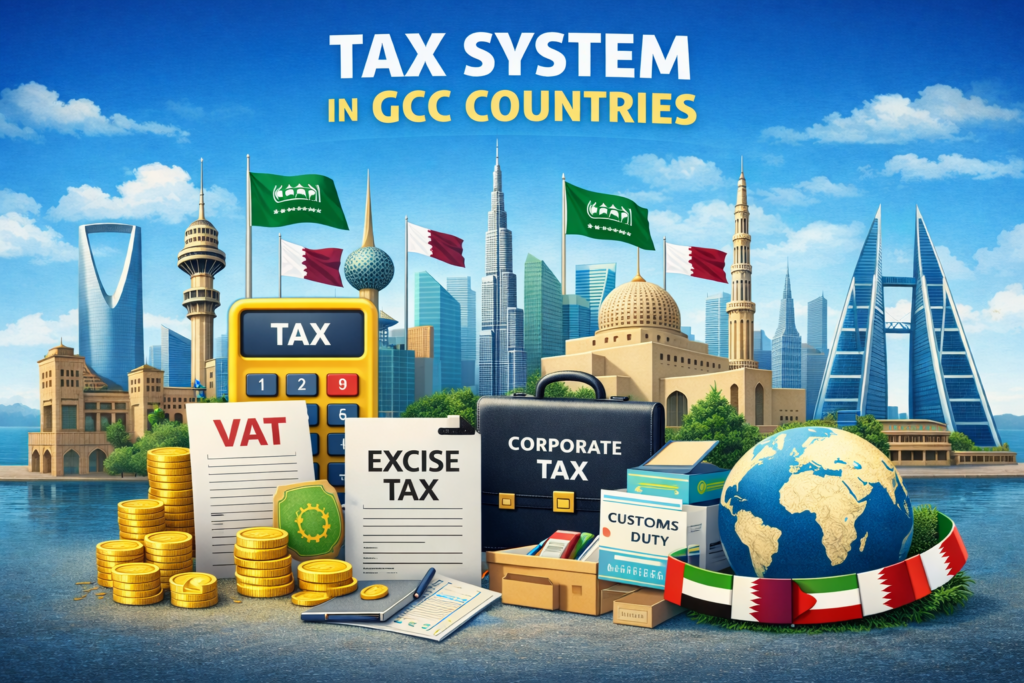
The tax system in GCC countries is often considered unique when compared to many other regions of the world. The Gulf Cooperation Council (GCC) includes six member countries: Saudi Arabia, United Arab Emirates (UAE), Qatar, Kuwait, Oman, and Bahrain. These nations are well known for their oil-based economies, strong government revenues, and relatively low tax burden on individuals.
Over the past few decades, the tax systems in GCC countries have gradually evolved. While they traditionally relied on oil and gas revenues instead of direct taxation, economic diversification and global financial standards have encouraged the introduction of structured tax frameworks such as Value Added Tax (VAT) and corporate taxes in some countries.
This article explains the tax system in GCC countries in a clear and beginner-friendly manner, covering types of taxes, country-wise approaches, key features, and future trends.
Overview of the GCC Tax System
The GCC tax system is characterized by:
- Low or zero personal income tax in most countries
- Selective taxation on businesses and specific sectors
- Indirect taxes such as VAT
- Strong government control and regulation
Unlike many Western economies, GCC countries focus more on indirect taxation rather than taxing individual salaries. This approach makes the region attractive for professionals, businesses, and foreign investors.
Personal Income Tax in GCC Countries
One of the most notable features of the GCC tax system is the absence of personal income tax in most member states.
Key Highlights
- No personal income tax on salaries or wages in most GCC countries
- Employees receive full salary without income tax deductions
- This policy attracts a large expatriate workforce
Currently, none of the GCC countries impose a traditional personal income tax on individuals’ salaries. However, residents may still be subject to other charges such as social security contributions or fees depending on the country.
Corporate Tax in GCC Countries
Corporate tax rules vary across GCC countries and mainly apply to foreign companies or specific industries.
General Features
- Local companies often enjoy tax exemptions
- Foreign companies may be taxed depending on business activity
- Oil, gas, and petrochemical companies are commonly taxed
Some GCC countries have introduced corporate tax frameworks to support economic diversification and meet international standards.
Value Added Tax (VAT) in GCC Countries
VAT is one of the most significant tax reforms introduced in the GCC region in recent years.
What Is VAT?
Value Added Tax (VAT) is an indirect tax applied to the sale of goods and services at each stage of the supply chain.
VAT in GCC
- VAT was introduced to reduce dependence on oil revenues
- Standard VAT rate is generally low compared to global standards
- Certain goods and services may be exempt or zero-rated
Not all GCC countries implemented VAT at the same time, but it is becoming an important part of government revenue.
Excise Tax in GCC Countries
Excise tax is applied to specific products that may be harmful to health or the environment.
Products Commonly Subject to Excise Tax
- Tobacco products
- Energy drinks
- Carbonated beverages
- Certain luxury or harmful items
The goal of excise tax is not only revenue generation but also promoting healthier lifestyles.
Customs Duties in GCC Countries
Customs duty is charged on imported goods entering GCC countries.
Key Points
- GCC countries follow a unified customs tariff
- Standard customs duty applies to most imported goods
- Certain essential items may be exempt
Customs duties support local industries and regulate trade across the region.
Country-Wise Overview of Tax Systems
United Arab Emirates (UAE)
The UAE has one of the most structured tax systems in the GCC:
- No personal income tax
- VAT introduced at a standard rate
- Corporate tax framework introduced for certain businesses
The UAE tax system focuses on ease of doing business and transparency.
Saudi Arabia
Saudi Arabia has a more diversified tax structure:
- No personal income tax for individuals
- Corporate tax applies mainly to foreign entities
- VAT and excise tax are significant revenue sources
The tax system supports the country’s long-term economic reforms.
Qatar
Qatar maintains a simple tax system:
- No personal income tax
- Corporate tax mainly applies to foreign-owned businesses
- VAT implementation planned as part of GCC alignment
Qatar’s tax policies aim to maintain a business-friendly environment.
Kuwait
Kuwait follows a limited taxation approach:
- No personal income tax
- Corporate tax applies to foreign companies
- No VAT implemented yet
The country relies heavily on oil revenue.
Oman
Oman has taken steps to modernize its tax system:
- No personal income tax
- Corporate tax applicable to businesses
- VAT introduced to support fiscal balance
Oman’s tax reforms focus on sustainability.
Bahrain
Bahrain has a relatively flexible tax system:
- No personal income tax
- VAT implemented at a moderate rate
- Corporate tax mainly applies to oil-related companies
Bahrain continues to attract regional and international businesses.
Advantages of the GCC Tax System
The tax system in GCC countries offers several benefits:
- Low tax burden on individuals
- Business-friendly environment
- High disposable income for residents
- Strong government support and infrastructure
These advantages contribute to economic growth and foreign investment.
Challenges in the GCC Tax System
Despite its strengths, the GCC tax system faces challenges:
- Dependence on oil revenues
- Implementation of new tax laws
- Public awareness and compliance
- Economic fluctuations
Governments are addressing these challenges through gradual reforms.
Future Trends in GCC Taxation
The future of the tax system in GCC countries is expected to include:
- Expansion of indirect taxes
- Improved tax compliance systems
- Greater transparency and digital tax platforms
- Alignment with international tax standards
These changes aim to support long-term economic stability.
FAQs About the Tax System in GCC
Do GCC countries have income tax?
Most GCC countries do not impose personal income tax on salaries.
Is VAT applicable in all GCC countries?
VAT has been implemented in some GCC countries, while others are planning or evaluating it.
Are businesses taxed in the GCC?
Certain businesses, especially foreign-owned and oil-related companies, are subject to corporate tax.
Conclusion
The tax system in GCC countries is unique due to its low personal taxation and increasing focus on indirect taxes. While individuals benefit from high take-home income, governments are gradually introducing structured tax systems to support economic diversification and long-term sustainability. Understanding how taxation works in the GCC helps individuals and businesses stay informed and compliant in this evolving financial environment.
Disclaimer
This article is for informational and educational purposes only. Tax laws and regulations may vary by country and are subject to change. Always refer to official government sources for the latest information.