Buying a home is one of the biggest financial decisions in the United Kingdom. Due to high property prices, most people rely on a home loan in UK, commonly known as a mortgage, to purchase a house or flat. A home loan in uk allows buyers to spread the cost of property over many years while living in the home.
The UK mortgage market is well-regulated and offers a wide range of loan options designed for first-time buyers, homeowners, and property investors. Understanding how home loans work in the UK is essential before applying, as it helps borrowers choose the right mortgage, manage repayments, and avoid financial stress.
This article explains what a home loan in UK is, types of mortgages, eligibility criteria, interest rates, repayment methods, and key factors to consider.
What Is a Home Loan in the UK?
A home loan (mortgage) in the UK is a secured loan provided by banks or mortgage lenders to purchase, build, or refinance a residential property. The property itself acts as security for the loan.
The borrower repays the loan in monthly instalments over a long period, usually 20 to 35 years, along with interest. If repayments are not made, the lender has the legal right to repossess the property.
How Home Loans Work in the UK
The basic working process of a home loan in uk is:
- Buyer chooses a property
- Applies for a mortgage from a lender
- Lender assesses affordability and credit profile
- Mortgage offer is issued
- Loan amount is paid to the seller
- Borrower repays monthly instalments
The amount you can borrow depends on income, expenses, and credit history.
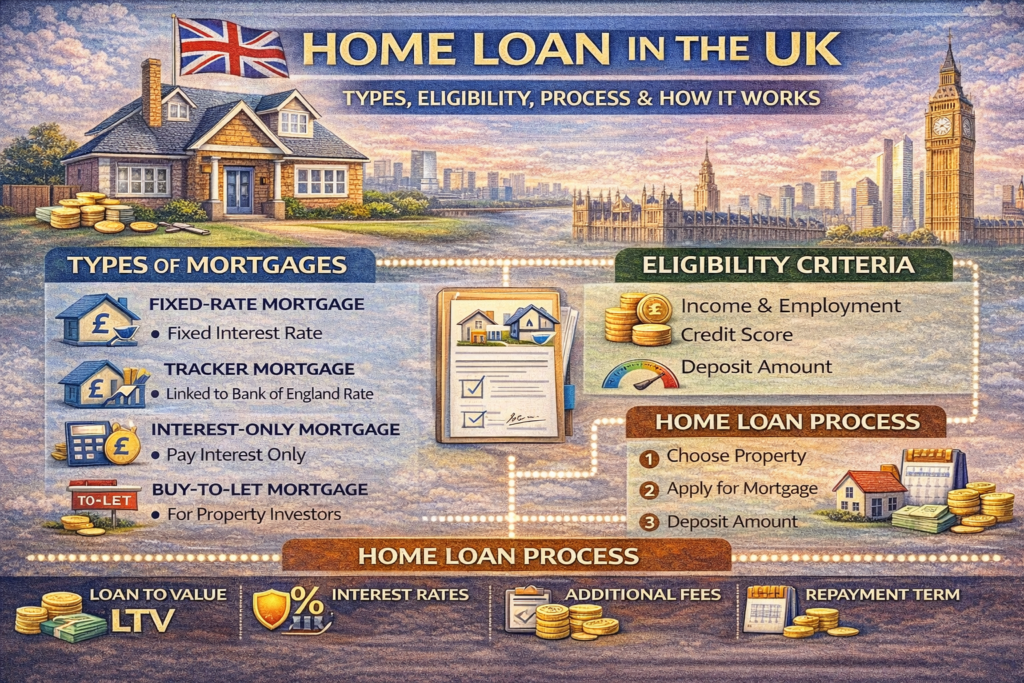
Types of Home Loans in the UK
UK mortgages come in several types, each suited to different financial situations.
Fixed-Rate Mortgage
A fixed-rate mortgage has an interest rate that stays the same for a fixed period.
Key Features
- Interest rate remains unchanged
- Monthly payments are predictable
- Fixed period usually 2–10 years
This option is popular with borrowers who prefer stability.
Variable-Rate Mortgage
Variable-rate mortgages have interest rates that can change.
Types Include
- Standard Variable Rate (SVR)
- Tracker mortgage (linked to Bank of England rate)
Payments may rise or fall depending on interest rate changes.
Tracker Mortgage
A tracker mortgage follows the Bank of England base rate.
Advantages
- Transparent rate structure
- Potentially lower rates when base rate falls
However, repayments increase if interest rates rise.
Discount Mortgage
A discount mortgage offers a reduced rate compared to the lender’s standard variable rate for a limited time.
Suitable For
- Borrowers expecting rates to remain stable
- Those comfortable with some uncertainty
Interest-Only Mortgage
With this mortgage, the borrower pays only interest during the loan term.
Important Points
- Lower monthly payments
- Loan principal must be repaid separately
- Higher long-term risk
Interest-only mortgages require a strong repayment plan.
Buy-to-Let Mortgage
Designed for property investors who rent out homes.
Features
- Higher deposit requirement
- Rental income considered
- Different eligibility criteria
Buy-to-let mortgages are not for personal residence.
Eligibility Criteria for Home Loans in The UK
Lenders assess several factors before approving a mortgage.
Key Eligibility Factors
- Age of applicant
- Income and employment status
- Credit score and credit history
- Existing debts
- Property value
Higher income and good credit history improve approval chances.
Deposit Requirements
In the UK, borrowers must pay a deposit.
Typical Deposit Range
- Minimum: 5% of property value
- Standard: 10–20%
- Higher deposit = better interest rates
First-time buyers often use government schemes to reduce deposit burden.
Loan-to-Value (LTV) Ratio
LTV represents the percentage of the property value borrowed.
Example
- Property price: £300,000
- Deposit: £30,000
- Mortgage: £270,000
- LTV: 90%
Lower LTV generally means lower interest rates.
Interest Rates on UK Home Loans
Interest rates vary based on market conditions and borrower profile.
Factors Affecting Interest Rates
- Bank of England base rate
- Loan-to-value ratio
- Credit score
- Mortgage type
Rates can be fixed or variable depending on the loan.
Mortgage Term
The mortgage term is the total repayment period.
Common Terms
- 20 years
- 25 years
- 30–35 years
Longer terms reduce monthly payments but increase total interest paid.
Repayment Structure
Most UK mortgages use monthly repayments.
Repayment Mortgage
- Pays both interest and principal
- Loan fully repaid by end of term
Interest-Only Mortgage
- Pays interest only
- Principal repaid separately
Fees Associated With Home Loans
UK mortgages include additional costs.
Common Fees
- Arrangement or product fee
- Valuation fee
- Legal fees
- Early repayment charges
These costs should be considered when comparing loans.
Government Home Buyer Schemes
The UK government offers schemes to support home buyers.
Examples
- Shared Ownership
- First Homes scheme
- Help for first-time buyers
Eligibility and benefits depend on individual circumstances.
Benefits of Taking a Home Loan in the UK
- Enables property ownership
- Spreads cost over long period
- Potential property value appreciation
- Predictable monthly payments (fixed rate)
A mortgage makes home ownership accessible.
Risks and Responsibilities
Home loans involve long-term commitment.
Key Risks
- Interest rate increases
- Loss of income
- Property repossession if payments are missed
Borrowers should plan carefully before committing.
Tips Before Applying for a UK Home Loan
- Check credit report
- Save for a larger deposit
- Compare lenders and mortgage types
- Understand total cost, not just interest rate
- Seek professional advice if needed
Preparation improves approval chances.
Home Loan vs Renting in the UK
| Aspect | Home Loan | Renting |
|---|---|---|
| Ownership | Yes | No |
| Monthly Cost | Mortgage payment | Rent |
| Long-Term Value | Builds equity | No asset |
| Flexibility | Less | More |
Choice depends on lifestyle and financial stability.
Frequently Asked Questions (FAQs)
Can foreigners get a home loan in UK?
Yes, subject to residency, income, and lender rules.
Is a mortgage the same as a home loan?
Yes, the term “mortgage” is commonly used in the UK.
Can I repay my mortgage early?
Early repayment may be allowed but could involve fees.
What credit score is needed?
A good credit score improves approval chances, but requirements vary.
Conclusion
A home loan in UK is a practical and structured way to achieve home ownership. With multiple mortgage types, flexible terms, and strong regulation, the UK mortgage market offers options for first-time buyers, homeowners, and investors. However, because a mortgage is a long-term financial commitment, understanding interest rates, repayment methods, and associated risks is essential.
By choosing the right mortgage and planning repayments carefully, borrowers can enjoy the benefits of owning a home while maintaining financial stability.
Disclaimer
This article is for informational and educational purposes only. Mortgage rules, interest rates, and eligibility criteria vary by lender and may change over time. Always consult official lenders or financial advisors before applying.