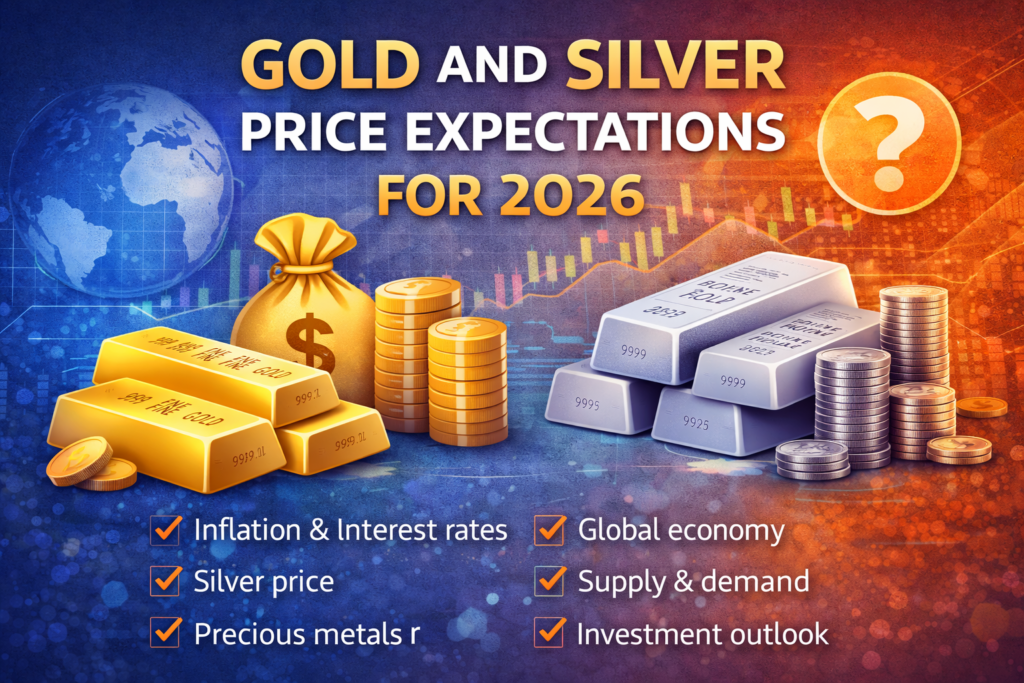
Gold and silver have always played a unique role in the global financial system. Unlike stocks or bonds, these precious metals are viewed as stores of value, inflation hedges, and safe-haven assets during periods of economic uncertainty. As the world moves through shifting interest rate cycles, geopolitical tensions, and evolving monetary policies, investors are increasingly focused on gold and silver price expectations for 2026.
While no forecast can guarantee exact price levels, analyzing macroeconomic trends, supply-demand dynamics, and investor behavior can help form realistic expectations. This article explores what may influence gold and silver prices in 2026 and how long-term investors might interpret these signals.
Global Economic Conditions and Their Impact on Precious Metals
The global economy is expected to remain complex through 2026. Slowing growth in developed economies, persistent inflationary pressures in some regions, and rising debt levels are likely to keep uncertainty elevated. Historically, such conditions tend to support gold and silver prices.
Gold, in particular, benefits when confidence in fiat currencies weakens. Large government deficits and high sovereign debt levels may push central banks to maintain accommodative policies longer than expected. If real interest rates (interest rates adjusted for inflation) remain low or negative, gold becomes more attractive because it does not rely on yield to generate value.
Silver, while also a monetary metal, reacts more strongly to economic growth cycles due to its industrial uses. A mixed global outlook could result in higher volatility for silver compared to gold, but it may also offer stronger upside during economic recoveries. gold and silver price expectations for 2026
Interest Rates, Inflation, and Central Bank Policies
One of the most important factors influencing gold and silver prices in 2026 will be central bank policy. Interest rate decisions directly affect the opportunity cost of holding non-yielding assets like precious metals.
If inflation remains sticky and central banks are cautious about aggressive rate hikes, gold prices may stay supported. Even modest inflation above target levels can strengthen demand for gold as a hedge against declining purchasing power.
Silver also benefits from inflation, but its response is often amplified by industrial demand. If central banks manage a “soft landing” and inflation stabilizes without triggering a recession, silver could outperform gold due to increased manufacturing activity alongside investment demand. gold and silver price expectations for 2026
Supply Constraints and Mining Challenges
On the supply side, both gold and silver face long-term structural challenges. Mining output growth has slowed over the past decade due to declining ore grades, rising production costs, and stricter environmental regulations. New large-scale discoveries are rare, and bringing new mines into production often takes many years.
Gold supply is relatively inelastic, meaning higher prices do not quickly result in significantly higher production. This characteristic tends to support prices during periods of rising demand.
Silver supply is more complex because a large portion of silver is produced as a by-product of mining other metals such as copper, zinc, and lead. This means silver supply is not always directly responsive to silver prices. If base metal production slows due to economic weakness, silver supply could tighten further, adding upward pressure on prices in 2026.
Industrial Demand and the Role of Technology
Silver has a strong advantage over gold when it comes to industrial demand. It is a critical component in sectors such as electronics, solar energy, electric vehicles, and medical equipment. As global investment in renewable energy and electrification continues, silver demand is expected to remain structurally strong through 2026.
The expansion of solar panel installations alone has become a major driver of silver consumption. Even with technological improvements that reduce silver usage per unit, overall demand may continue rising due to scale.
Gold, on the other hand, has limited industrial use but remains highly valued in jewelry and investment markets. Demand from emerging economies, where gold is deeply embedded in cultural and financial traditions, could continue supporting prices even if Western investment demand fluctuates.
Investor Sentiment and Market Expectations
Investor psychology plays a crucial role in shaping precious metal prices. In times of financial stress, gold often attracts capital as a perceived safe haven. Silver tends to follow gold’s direction but with greater price swings due to its smaller market size.
By 2026, if equity markets experience higher volatility or if confidence in traditional assets weakens, both metals could benefit from renewed investor interest. Exchange-traded products, digital trading platforms, and easier access to bullion have made investing in precious metals more accessible than ever, amplifying price movements during strong sentiment shifts.
However, if global markets remain stable and interest-bearing assets offer attractive real returns, gold and silver prices could face periods of consolidation rather than explosive growth. gold and silver price expectations for 2026
Gold Price Expectations for 2026
Looking ahead to 2026, gold is widely expected to maintain a strong long-term outlook. While short-term fluctuations are inevitable, many analysts anticipate gold prices to remain well supported due to macroeconomic uncertainty, central bank diversification, and long-term inflation risks.
Central banks have been increasing their gold reserves in recent years as a way to diversify away from traditional reserve currencies. If this trend continues, it could provide a steady source of demand that helps limit downside risk. gold and silver price expectations for 2026
Rather than focusing on exact price targets, investors may view gold in 2026 as a stability asset—less about rapid gains and more about preserving value and reducing portfolio risk.
Silver Price Expectations for 2026
Silver’s outlook for 2026 is more dynamic and potentially more volatile than gold’s. Its dual role as both a precious and industrial metal means silver prices can react strongly to changes in economic growth, technology adoption, and investor sentiment.
If global demand for renewable energy, electric vehicles, and electronics continues expanding, silver could experience periods of strong upward momentum. At the same time, silver is historically prone to sharper corrections during economic slowdowns.
For investors with a higher risk tolerance, silver may offer greater upside potential than gold in 2026, but it also requires a longer-term perspective to manage volatility effectively. gold and silver price expectations for 2026
Risks That Could Affect Gold and Silver Prices
While the long-term fundamentals appear supportive, several risks could influence gold and silver prices in unexpected ways. A sharp rise in real interest rates, stronger-than-expected economic growth, or major technological breakthroughs reducing metal usage could all limit price gains.
Currency movements, particularly the strength of the US dollar, also play a significant role. A strong dollar typically pressures precious metal prices, while a weaker dollar tends to support them.
Geopolitical developments, trade policies, and changes in environmental regulations may further impact both demand and supply dynamics as 2026 approaches. gold and silver price expectations for 2026
Final Thoughts: What 2026 May Hold for Precious Metals
Gold and silver are likely to remain relevant and closely watched assets in 2026. Gold may continue to serve as a reliable hedge against uncertainty, inflation, and currency risk, while silver could benefit from its growing importance in modern technology and green energy initiatives.
Rather than viewing precious metals as short-term speculation, many investors consider them part of a diversified, long-term strategy. As global economic conditions evolve, gold and silver may continue to offer balance and resilience within investment portfolios.
While exact price levels are impossible to predict, understanding the forces shaping supply, demand, and investor behavior can help set realistic expectations for gold and silver in 2026 and beyond.