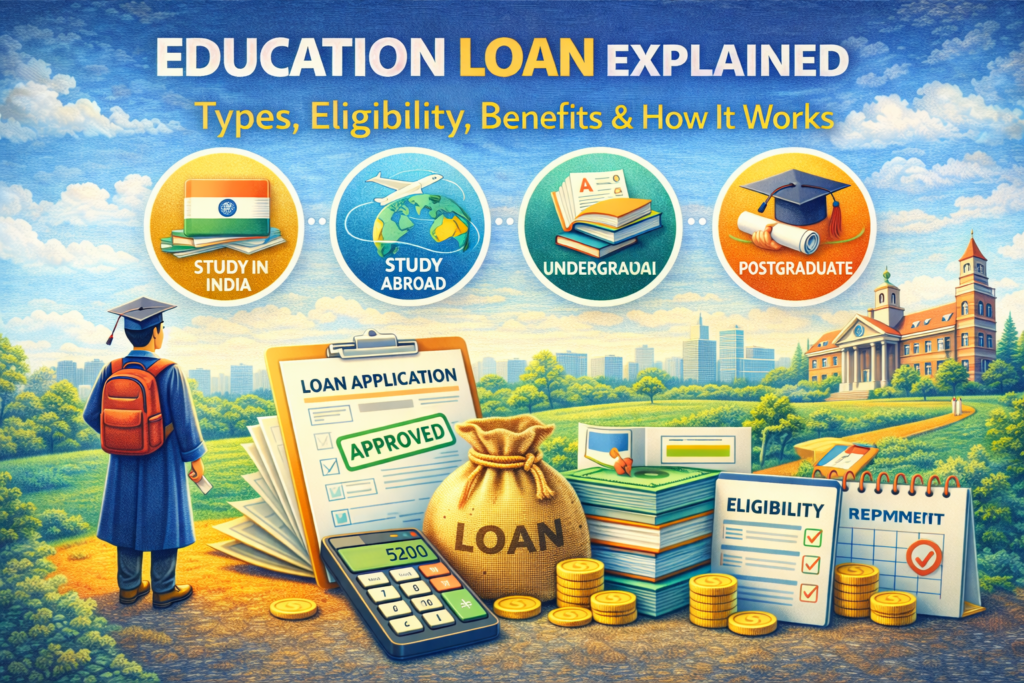
Education plays a vital role in shaping an individual’s future, but the rising cost of quality education has made higher studies expensive for many families. Tuition fees, accommodation, books, travel, and other related expenses can place a significant financial burden on students and parents. An education loan helps bridge this gap by providing financial support to pursue academic goals without immediate financial stress.
Education loans are designed specifically to fund studies in India or abroad. They usually offer lower interest rates than personal loans, longer repayment periods, and flexible repayment options. Understanding how education loans work is important before applying, as it involves long-term planning and responsibility.
This article explains what an education loan is, its types, eligibility, benefits, repayment process, and key considerations, in a simple and beginner-friendly manner.
What Is an Education Loan?
An education loan is a financial product offered by banks and financial institutions to help students pay for higher education. The loan amount is used to cover education-related expenses, and repayment usually begins after the completion of studies.
Education loans are considered investment-oriented loans because they support skill development and career growth. In many cases, a parent or guardian acts as a co-applicant to strengthen the loan application.
Expenses Covered Under an Education Loan
Education loans typically cover a wide range of academic expenses, including:
- Tuition fees
- Examination and library fees
- Hostel or accommodation charges
- Books and study materials
- Equipment such as laptops (in some cases)
- Travel expenses for overseas education
- Insurance or caution deposits (where applicable)
The exact coverage may vary by lender and course.
Types of Education Loans
Education loans are classified based on the location and nature of studies.
1. Education Loan for Studies in India
This loan is taken for higher education within the country.
Common courses covered:
- Undergraduate and postgraduate programs
- Professional courses such as engineering, medicine, management
- Diploma and technical courses
These loans usually have lower interest rates and simpler documentation.
2. Education Loan for Studies Abroad
This loan is designed for students pursuing education in foreign countries.
Covers:
- International tuition fees
- Living expenses
- Travel and visa costs
Loan amounts are generally higher due to increased costs of overseas education.
3. Undergraduate Education Loan
Used to finance bachelor-level programs.
Features:
- Smaller loan amount
- Longer moratorium period
- Focus on academic potential
4. Postgraduate Education Loan
Designed for master’s or professional degrees.
Advantages:
- Higher loan eligibility
- Better repayment prospects due to advanced qualifications
5. Skill-Based or Vocational Education Loan
Supports specialized training or skill development programs that improve employability.
Eligibility Criteria for Education Loans
Eligibility requirements may differ across lenders, but common factors include:
Student Eligibility
- Must be an Indian citizen or eligible resident
- Secured admission to a recognized institution
- Strong academic background
Co-Applicant Eligibility
- Parent, guardian, or spouse
- Stable income source
- Good credit history
The co-applicant’s financial profile plays a major role in loan approval.
Documents Required for an Education Loan
Documentation is an important part of the loan application process.
Student Documents
- Identity and address proof
- Academic records
- Admission letter from the institution
Co-Applicant Documents
- Identity and address proof
- Income proof (salary slips, bank statements)
- Tax-related documents (if required)
Course-Related Documents
- Fee structure
- Course duration details
- Institution accreditation proof
Interest Rates on Education Loans
Education loan interest rates are usually lower than personal loans but higher than home loans.
Factors Affecting Interest Rates
- Loan amount
- Course and institution type
- Study location (India or abroad)
- Credit profile of co-applicant
Some lenders may offer special rates for certain institutions or courses.
Repayment Structure of Education Loans
Education loans have a unique repayment structure compared to other loans.
Moratorium Period
The moratorium period is the time during which repayment is not required.
It usually includes:
- Course duration
- Additional grace period after course completion
During this time, interest may accrue depending on lender policy.
Repayment Tenure
- Repayment usually starts after the moratorium period
- Tenure can range from 5 to 15 years
- Longer tenure reduces monthly burden
How Education Loan EMIs Work
Once repayment begins, the loan is repaid through Equated Monthly Installments (EMIs).
EMI includes:
- Principal amount
- Interest component
Proper planning ensures manageable monthly payments after graduation.
Benefits of Education Loans
Education loans offer several advantages:
- Makes higher education accessible
- Lower interest rates compared to unsecured loans
- Flexible repayment structure
- Long repayment tenure
- Supports career growth and skill development
Education loans are often considered a long-term investment in the future.
Secured vs Unsecured Education Loans
Education loans can be secured or unsecured based on the loan amount.
Secured Education Loan
- Requires collateral such as property or fixed deposit
- Lower interest rates
- Higher loan amount
Unsecured Education Loan
- No collateral required
- Higher interest rates
- Lower loan amount
Choice depends on financial capacity and loan size.
Risks and Responsibilities of Education Loans
While education loans are beneficial, they also carry responsibilities.
Potential Risks
- Repayment pressure if employment is delayed
- Interest accumulation during moratorium
- Impact on credit score if EMIs are missed
Responsible planning is essential before borrowing.
Tips Before Applying for an Education Loan
Consider these points before applying:
- Choose a recognized institution
- Understand total education cost
- Compare lenders and interest rates
- Review repayment terms carefully
- Plan future income and expenses
Good preparation improves approval chances and reduces future stress.
Education Loan vs Personal Loan
Education loans are different from personal loans.
| Aspect | Education Loan | Personal Loan |
|---|---|---|
| Purpose | Education-specific | Any purpose |
| Interest Rate | Lower | Higher |
| Repayment Start | After studies | Immediate |
| Tenure | Long | Short |
Education loans are generally more student-friendly.
Frequently Asked Questions (FAQs)
Can education loans be taken for online courses?
Some lenders may support recognized online or distance programs.
Is collateral mandatory?
Collateral depends on the loan amount and lender policy.
Can students repay early?
Many lenders allow prepayment under certain conditions.
Does education loan affect credit score?
Yes, repayment behavior affects credit history.
Importance of Responsible Borrowing
An education loan should be viewed as a stepping stone, not a burden. Borrowers should choose courses with strong career potential and plan repayment carefully. Responsible borrowing ensures financial stability after completing education.
Conclusion
An education loan is a powerful financial tool that helps students achieve academic and career goals without immediate financial pressure. By covering tuition fees and related expenses, education loans make higher education accessible to a wider population. With lower interest rates, flexible repayment options, and long tenures, they are well-suited for students planning their future.
Understanding the terms, responsibilities, and repayment structure of education loans helps students and families make informed decisions. When used wisely, an education loan becomes an investment that pays long-term returns through knowledge, skills, and career growth.
Disclaimer
This article is for informational and educational purposes only. Education loan terms, interest rates, and eligibility criteria vary by lender and region. Always refer to official lender information before applying.