The banking system in United Kingdom is one of the oldest and most developed in the world. As a global financial hub, the UK plays a key role in international banking, finance, and trade. London, in particular, is considered one of the world’s leading financial centers, hosting major banks, financial institutions, and markets.
The UK banking system supports individuals, businesses, and the government by providing essential services such as savings accounts, loans, payment systems, and investment facilities. It operates under a strong regulatory framework designed to ensure stability, transparency, and customer protection.
This article explains the banking system in the UK, including its structure, types of banks, regulatory authorities, and the role it plays in the economy.
Overview of the UK Banking System
The UK banking system is a market-oriented and well-regulated financial system. It includes a mix of large multinational banks, retail banks, building societies, and digital-only banks. Unlike some countries with highly centralized banking models, the UK allows strong competition among different types of institutions.
The system focuses on:
- Financial stability
- Consumer protection
- Innovation and digital banking
- International financial services
Importance of the Banking System in the UK
The banking system is vital to the UK economy because it:
- Supports household savings and spending
- Provides credit to businesses
- Facilitates domestic and international payments
- Supports trade and investment
- Helps implement monetary policy
A strong banking system contributes directly to economic growth and financial confidence.
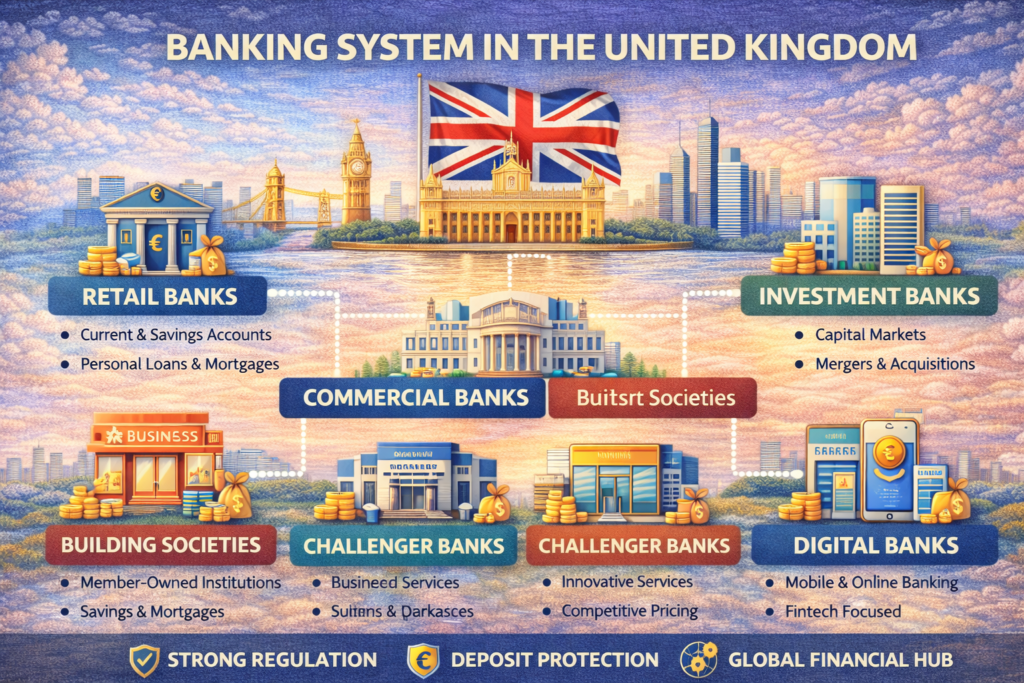
Types of Banks in the United Kingdom
Banks in the UK can be broadly classified into several categories based on their functions.
1️⃣ Retail Banks
Retail banks provide everyday banking services to individuals and small businesses.
Services Offered
- Current and savings accounts
- Debit and credit cards
- Personal loans and mortgages
- Online and mobile banking
Retail banks are the most commonly used banks by the general public. Banking System in United Kingdom : Structure, Types of Banks & How It Works
2️⃣ Commercial Banks
Commercial banks serve businesses, corporations, and institutions.
Key Functions
- Business loans and credit facilities
- Trade finance
- Cash management services
- Corporate accounts
Many large UK banks operate as both retail and commercial banks.
3️⃣ Investment Banks
Investment banks focus on capital markets and large financial transactions.
Services Include
- Mergers and acquisitions advisory
- Capital raising
- Securities trading
- Asset management
London’s global financial status is strongly supported by investment banking activities.
4️⃣ Building Societies
Building societies are unique financial institutions in the UK.
Key Characteristics
- Member-owned institutions
- Focus on savings and mortgages
- Profits are reinvested for member benefit
Building societies play an important role in home financing and community banking.
5️⃣ Challenger Banks
Challenger banks are newer banks created to increase competition.
Features
- Customer-focused services
- Innovative products
- Competitive pricing
They offer alternatives to traditional high-street banks.
6️⃣ Digital and Online Banks
Digital banks operate mainly through mobile apps and online platforms.
Advantages
- Easy account opening
- Lower operating costs
- User-friendly technology
Digital banking is growing rapidly in the UK.
Role of the Central Bank in the UK
The Bank of England is the central bank of the United Kingdom.
Key Responsibilities
- Issuing currency
- Managing monetary policy
- Controlling inflation
- Ensuring financial stability
The Bank of England plays a central role in maintaining confidence in the financial system.
Monetary Policy in the UK
Monetary policy in the UK is aimed at controlling inflation and supporting economic growth.
Tools Used
- Interest rate adjustments
- Open market operations
- Liquidity support to banks
Interest rate decisions directly affect loans, savings, and borrowing costs.
Regulation and Supervision of UK Banks
The UK banking system is tightly regulated to protect customers and ensure stability.
Main Regulatory Bodies
- Financial Conduct Authority (FCA)
- Prudential Regulation Authority (PRA)
- Bank of England
These regulators oversee:
- Bank capital requirements
- Risk management
- Consumer protection
- Anti-money laundering measures
Deposit Protection in the UK
Customer deposits in UK banks are protected under a deposit guarantee scheme.
Key Points
- Protects eligible deposits up to a fixed limit
- Covers savings and current accounts
- Applies if a bank fails
Deposit protection increases public trust in the banking system. The banking system in United Kingdom
Banking Services for Individuals
UK banks offer a wide range of services for individuals.
Common Services
- Current accounts
- Savings accounts
- Fixed deposits
- Personal loans
- Mortgages
Modern UK banking emphasizes digital convenience and transparency.
Banking Services for Businesses
Businesses rely on UK banks for operational and growth needs.
Business Banking Services
- Business accounts
- Overdraft facilities
- Loans and financing
- Payment and payroll services
Small and medium-sized enterprises (SMEs) are a key focus area.
International Role of UK Banking
The UK plays a major role in global finance.
- London hosts many international banks
- UK banks support global trade
- Strong presence in foreign exchange and capital markets
The UK’s banking system is deeply connected to the global financial system.
Digital Transformation of UK Banking
Technology has transformed banking in the UK.
Key Developments
- Mobile banking apps
- Contactless payments
- Online loan approvals
- Open banking initiatives
Digital innovation has improved efficiency and customer experience. The banking system in United Kingdom
Open Banking in the UK
Open banking allows customers to share financial data securely with third-party providers.
Benefits
- Better financial management tools
- Increased competition
- Personalized banking services
The UK is one of the global leaders in open banking adoption.
Challenges Facing the UK Banking System
Despite its strength, the system faces challenges.
Key Challenges
- Cybersecurity risks
- Regulatory compliance costs
- Economic uncertainty
- Competition from fintech firms
Banks continue to adapt through innovation and risk management.
Advantages of the UK Banking System
- Strong regulation
- Global reach
- Advanced digital infrastructure
- High consumer protection standards
These strengths make the UK a trusted financial environment. The banking system in United Kingdom
Banking System in the UK vs Other Countries
Compared to many countries, the UK banking system is:
- More internationally connected
- Highly competitive
- Technology-driven
This makes it attractive for global finance and investment. The banking system in United Kingdom
Importance of the UK Banking System
The UK banking system supports:
- Economic growth
- Employment
- Housing market
- International trade
It is a cornerstone of the UK economy.
Frequently Asked Questions (FAQs)
Is the UK banking system safe?
Yes, it is considered stable and well-regulated.
Who regulates banks in the UK?
Banks are regulated by the FCA, PRA, and Bank of England.
Are deposits protected in UK banks?
Yes, eligible deposits are protected under a deposit guarantee scheme.
Can foreigners open bank accounts in the UK?
Yes, subject to identification and residency requirements.
Conclusion
The banking system in United Kingdom is a modern, diverse, and globally influential financial framework. With a mix of retail banks, commercial banks, building societies, and digital institutions, the system effectively serves individuals, businesses, and international markets. Strong regulation, advanced technology, and consumer protection have helped the UK maintain a resilient and trusted banking environment.
Understanding how the UK banking system works provides valuable insight into one of the world’s most important financial ecosystems.
Disclaimer
This article is for informational and educational purposes only. Banking rules, regulations, and services may change over time. Always consult official bank or regulatory sources for the latest information.