Germany has one of the strongest and most stable banking systems in the world. As Europe’s largest economy, Germany relies on a well-regulated and diversified financial system to support businesses, households, and international trade. The banking system in Germany is known for its three-pillar structure, strong regulation, and focus on stability rather than excessive risk-taking.
Unlike some countries where banking is dominated by a few large private institutions, Germany’s banking system includes public, cooperative, and private banks, each serving different segments of the economy. This diversity helps ensure financial inclusion, regional development, and economic resilience.
This article explains the banking system in Germany, its structure, types of banks, regulatory framework, and how it supports individuals and businesses.
Overview of the German Banking System
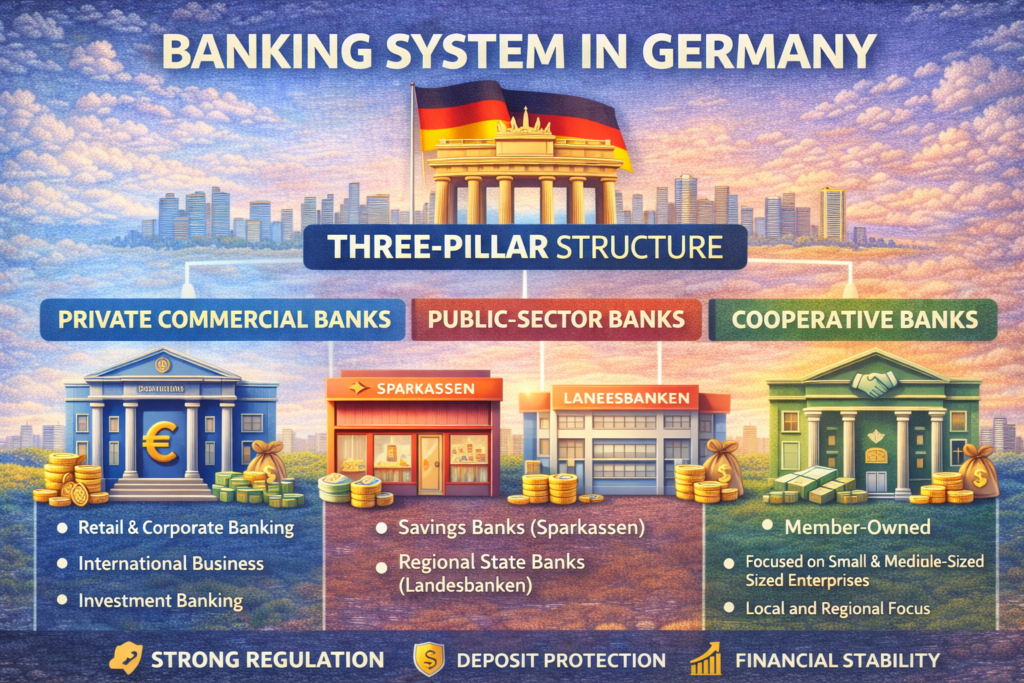
The German banking system operates under a three-pillar model, which makes it unique compared to many other countries. These pillars work alongside each other rather than competing aggressively, creating balance and stability.
The Three Pillars Are:
- Private Commercial Banks
- Public-Sector Banks
- Cooperative Banks
Each pillar has a specific role in serving customers and supporting the economy.
Why Germany’s Banking System Is Considered Strong
Germany’s banking system is respected globally due to:
- Strong regulatory oversight
- Conservative risk management
- Wide regional banking network
- Focus on long-term economic stability
- Strong customer protection mechanisms
This structure helped Germany handle global financial crises more effectively than many countries.
1️⃣ Private Commercial Banks
Private commercial banks operate for profit and offer a wide range of financial services.
Key Features
- Operate nationally and internationally
- Serve individuals, businesses, and corporations
- Offer retail, corporate, and investment banking services
Services Provided
- Savings and current accounts
- Loans and mortgages
- Credit cards
- Business financing
- International banking services
Private banks are commonly used for international transactions and corporate banking.
2️⃣ Public-Sector Banks
Public-sector banks are owned by regional governments or public institutions. They play a major role in supporting local economies and public development goals banking system in Germany,
Types of Public Banks
- Savings Banks (Sparkassen)
- Regional State Banks (Landesbanken)
Savings Banks (Sparkassen)
Savings banks focus on local communities and individuals.
Key Characteristics
- Regionally focused
- Public ownership
- Strong emphasis on retail customers and small businesses
They support:
- Local households
- Small and medium-sized enterprises (SMEs)
- Regional economic development
Savings banks are extremely popular in Germany due to trust and accessibility.
Landesbanken
Landesbanken serve as regional wholesale banks and support savings banks.
Functions
- Corporate and international financing
- Capital market activities
- Infrastructure financing
They also act as clearing banks for local savings banks.
3️⃣ Cooperative Banks
Cooperative banks are owned by their members and operate on a mutual benefit model.
Key Principles
- Customer-owned structure
- Democratic decision-making
- Focus on member benefits rather than profit maximization
Services Offered
- Retail banking
- Agricultural financing
- Small business loans
- Savings and investment products
Cooperative banks play a crucial role in rural and regional financial inclusion.
Role of the Central Bank in Germany
Germany’s central banking functions are carried out by the Deutsche Bundesbank, which is part of the European System of Central Banks (ESCB).
Responsibilities
- Implementing monetary policy (with the ECB)
- Maintaining price stability
- Managing currency circulation
- Ensuring financial stability
Since Germany uses the euro, monetary policy decisions are made by the European Central Bank (ECB).
Regulation and Supervision of Banks
Germany has a strict regulatory framework to ensure banking safety.
Key Regulatory Authorities
- BaFin (Federal Financial Supervisory Authority)
- Deutsche Bundesbank
- European Central Bank (ECB)
These institutions oversee:
- Capital adequacy
- Risk management
- Consumer protection
- Anti-money laundering compliance
Deposit Protection in Germany
Customer deposits are protected under Germany’s deposit guarantee system.
Key Points
- Deposits are protected up to a certain limit
- Applies to savings and current accounts
- Mandatory for all licensed banks
This protection increases public confidence in the banking system.
Digital Banking in Germany
Germany has seen rapid growth in digital and online banking services.
Features of Digital Banking
- Online account opening
- Mobile banking apps
- Digital payments
- Online loans and investments
Traditional banks and digital-only banks coexist, offering customers multiple choices.
Banking Services for Individuals
German banks provide a wide range of services for individuals.
Common Services
- Savings accounts
- Current accounts
- Fixed deposits
- Personal loans
- Mortgage financing
Banks focus on transparency and customer protection.
Banking Services for Businesses
Businesses rely heavily on German banks for financing and operations.
Business Services Include
- Working capital loans
- Trade finance
- Investment loans
- Cash management services
Small and medium-sized enterprises benefit significantly from local and cooperative banks.
International Role of German Banks
Germany plays a major role in global banking and finance.
- Strong presence in European markets
- Support for international trade
- Financing of global infrastructure projects
German banks are known for reliability in international transactions.
Challenges Facing the German Banking System
Despite its strength, the system faces challenges.
Key Challenges
- Low interest rate environment
- Increased regulatory costs
- Competition from digital banks
- Cybersecurity risks
Banks continue to adapt through innovation and digital transformation.
Advantages of the German Banking System
- High stability
- Strong consumer protection
- Wide access to banking services
- Balanced competition
These advantages make Germany’s banking system one of the most trusted globally.
Banking System in Germany vs Other Countries
Compared to many countries, Germany’s system is:
- More decentralized
- Less risk-oriented
- More focused on regional development
This approach supports long-term economic growth.
Importance of the Banking System in Germany
The banking system supports:
- Economic stability
- Employment generation
- Business growth
- International trade
It plays a key role in Germany’s economic success.
Frequently Asked Questions (FAQs)
Is Germany’s banking system safe?
Yes, it is considered one of the safest in the world.
Who regulates banks in Germany?
Banks are regulated by BaFin, the Bundesbank, and the ECB.
Are deposits protected in Germany?
Yes, deposits are protected under deposit guarantee schemes.
Can foreigners open bank accounts in Germany?
Yes, subject to identification and residency rules.
Conclusion
The banking system in Germany is a well-structured, stable, and diversified financial framework that supports both individuals and businesses. Its three-pillar structure—private, public, and cooperative banks—ensures balanced competition, financial inclusion, and regional development. Strong regulation, customer protection, and conservative risk management have helped Germany maintain a resilient banking system even during global financial challenges.
Understanding how the German banking system works provides valuable insight into why Germany remains one of the world’s strongest economies.
Disclaimer
This article is for informational and educational purposes only. Banking regulations and services may change over time. Always refer to official bank or regulatory sources for current information.