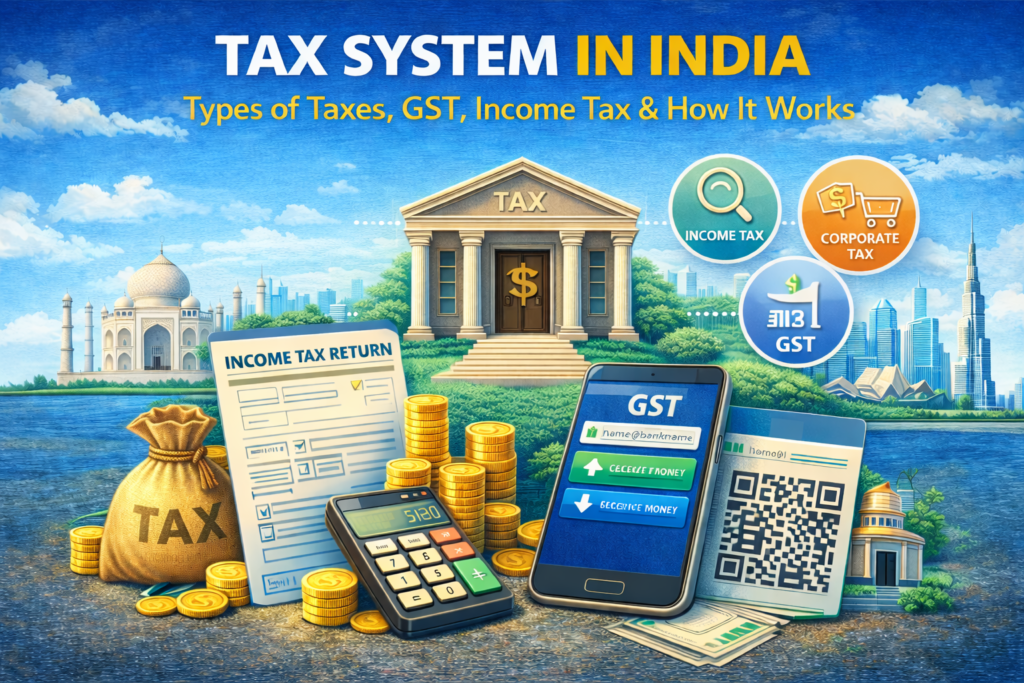
The tax system in India plays a crucial role in funding government activities and supporting the country’s economic development. Taxes collected by the government are used to build infrastructure, provide healthcare and education, support social welfare schemes, and maintain public services. With a large population and a diverse economy, India follows a structured tax system that includes both direct and indirect taxes.
India’s tax system has evolved significantly over the years. Reforms such as the introduction of the Goods and Services Tax (GST) have simplified taxation and improved transparency. Understanding how the Indian tax system works helps individuals and businesses stay compliant and make informed financial decisions.
This article explains the tax system in India in a simple and easy-to-understand manner, covering types of taxes, income tax, GST, corporate tax, and the overall working mechanism.
Overview of the Indian Tax System
The Indian tax system is administered by the central government and state governments. Taxes are broadly divided into direct taxes and indirect taxes.
- Direct taxes are paid directly by individuals or organizations to the government.
- Indirect taxes are collected through goods and services and paid indirectly by consumers.
The system aims to balance revenue generation with economic growth and social welfare.
Why Taxes Are Collected in India
Taxes are collected in India to:
- Fund public infrastructure such as roads, railways, and airports
- Support education and healthcare systems
- Finance government welfare schemes
- Maintain national defense and security
- Promote economic development
Without tax revenue, the government would not be able to provide essential public services.
Types of Taxes in India
Direct Taxes
Direct taxes are imposed directly on income or profits.
Income Tax
Income tax is charged on the income earned by individuals, professionals, and businesses.
Key points:
- Applies to salary, business income, and other earnings
- Rates vary based on income slabs
- Collected annually through income tax returns
Corporate Tax
Corporate tax is paid by companies on their profits.
Features:
- Applies to domestic and foreign companies operating in India
- Rates vary based on company size and structure
- Important source of government revenue
Indirect Taxes
Indirect taxes are levied on goods and services.
Goods and Services Tax (GST)
GST is one of the most important tax reforms in India. It replaced multiple indirect taxes with a unified tax system.
What Is GST?
GST is a consumption-based tax applied at every stage of the supply chain.
Benefits of GST
- Simplified tax structure
- Reduced tax cascading
- Improved transparency
- Easier compliance
GST is collected by both central and state governments.
Other Important Taxes in India
Customs Duty
Charged on goods imported into or exported from India.
Excise Duty
Applied mainly to specific products such as fuel and alcohol.
Property Tax
Collected by local municipal authorities on property ownership.
Income Tax System in India
Income tax in India follows a slab-based structure.
Key Features
- Different tax slabs for different income levels
- Separate tax regimes with varying deductions
- Mandatory filing for eligible taxpayers
Income tax is administered by the Income Tax Department.
How Taxes Are Collected in India
Tax collection follows a structured process:
- Registration with tax authorities
- Income reporting through returns
- Tax assessment
- Tax payment via online or bank channels
Digital platforms have made tax filing easier and faster.
Digital Tax Filing in India
India has adopted digital tax systems to improve efficiency.
Benefits include:
- Online return filing
- Faster processing
- Reduced paperwork
- Increased transparency
Digitalization has improved tax payer convenience significantly.
Challenges in the Indian Tax System
Despite improvements, challenges remain:
- Tax evasion
- Complexity for new taxpayers
- Awareness issues
- Compliance burden for small businesses
The government continues to introduce reforms to address these issues.
Importance of Understanding India’s Tax System
Understanding the tax system helps individuals:
- Avoid penalties
- Plan finances better
- Stay compliant with laws
- Contribute to national development
Financial awareness leads to responsible citizenship.
FAQs on Tax System in India
Is income tax mandatory in India?
Yes, eligible individuals must pay income tax.
What is GST used for?
GST is used to fund government services and development.
Are tax laws the same across India?
Direct taxes are uniform, but some indirect taxes vary by state.
Conclusion
The tax system in India is a structured framework designed to support economic growth and public welfare. With a mix of direct and indirect taxes, India ensures revenue generation while promoting transparency and fairness. Reforms like GST and digital tax filing have modernized the system, making compliance easier for taxpayers.
Understanding how the Indian tax system works empowers individuals and businesses to manage their finances responsibly and contribute to the nation’s progress.
Disclaimer
This article is for informational and educational purposes only. Tax laws may change over time. Always refer to official government sources for the latest information.