
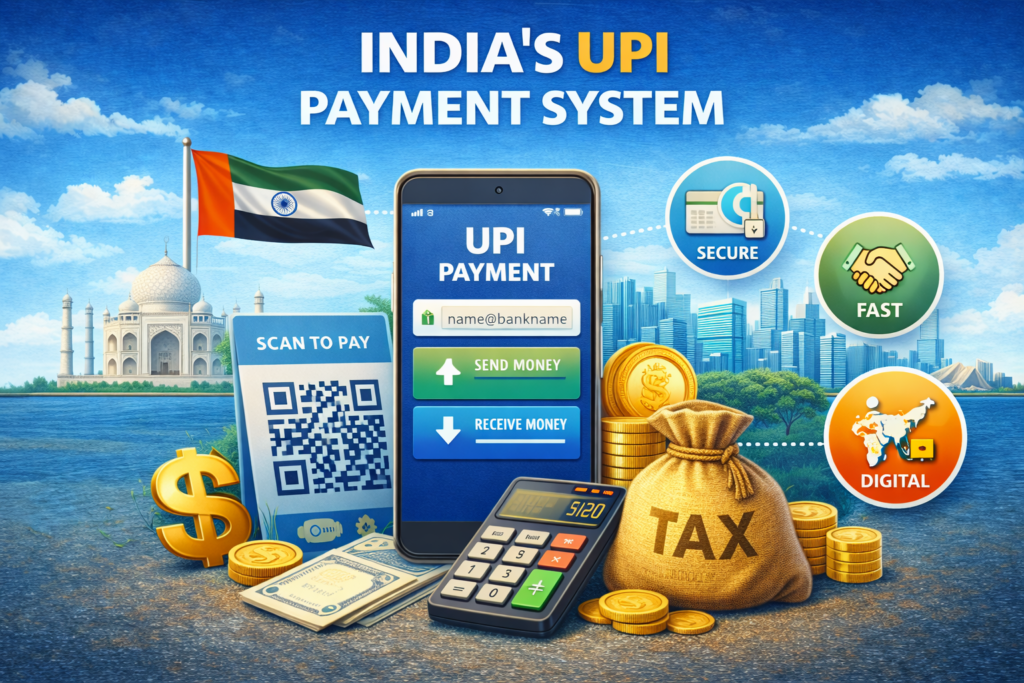
India’s digital payment landscape has undergone a major transformation over the last decade, and the Unified Payments Interface (UPI) has been at the center of this change. Introduced as a real-time payment system, UPI payment system has made sending and receiving money simple, fast, and accessible to millions of people across the country. From small street vendors to large businesses, UPI is now widely used for daily transactions.
UPI allows users to transfer money instantly between bank accounts using a mobile phone, without the need to share sensitive bank details. Its ease of use, security, and wide acceptance have helped it become one of the most successful digital payment systems in the world.
This article explains India’s UPI payment system in detail, including how it works, its key features, benefits, challenges, and future potential.
What Is UPI?
UPI stands for Unified Payments Interface. It is a digital payment system that enables instant bank-to-bank money transfers through a mobile application. UPI Payment System was developed by the National Payments Corporation of India (NPCI) and launched with the support of the Reserve Bank of India (RBI).
UPI connects multiple bank accounts into a single mobile application, allowing users to make payments using a virtual payment address (VPA), mobile number, or QR code. The system operates 24/7, including weekends and holidays.
How UPI Works
UPI works by linking a user’s bank account to a UPI-enabled mobile app. Once the setup is complete, users can send or receive money instantly.
Basic Working Process
- The user installs a UPI app provided by a bank or authorized payment provider.
- The app is linked to the user’s bank account using a registered mobile number.
- A unique UPI ID (Virtual Payment Address) is created.
- Payments can be made using the UPI ID, QR code, or mobile number.
- Transactions are authenticated using a secure UPI PIN.
The entire process takes only a few seconds.
Key Features of UPI
UPI offers several features that make it user-friendly and efficient.
Real-Time Transactions
UPI enables instant money transfer between bank accounts, eliminating delays.
24/7 Availability
UPI works round the clock, including public holidays.
Single Platform for Multiple Banks
Users can link multiple bank accounts to one UPI app.
Secure Authentication
Every transaction requires a UPI PIN, ensuring safety.
Low Cost
UPI transactions are generally free or involve minimal charges.
Types of Transactions Supported by UPI
UPI supports a wide range of financial transactions.
- Person-to-person money transfers
- Payments to merchants
- Utility bill payments
- Online shopping payments
- Subscription and recurring payments
This versatility has made UPI suitable for both personal and business use.
Benefits of UPI for Users
Convenience
UPI eliminates the need to carry cash or remember bank account numbers.
Speed
Transactions are completed instantly, saving time.
Accessibility
UPI can be used by anyone with a smartphone and a bank account.
Transparency
Users receive immediate transaction confirmation.
Financial Inclusion
UPI has helped bring digital payments to rural and semi-urban areas.
Benefits of UPI for Businesses
UPI has also benefited businesses of all sizes.
- Faster payment collection
- Reduced dependence on cash
- Easy integration with existing systems
- Improved transaction tracking
Small merchants can accept UPI payments using simple QR codes.
Security Measures in UPI
Security is a key aspect of the UPI system.
Key Security Features
- Two-factor authentication
- Encrypted transaction data
- Secure UPI PIN system
- Bank-level monitoring
Users are advised to keep their UPI PIN confidential and avoid sharing sensitive information.
Role of Banks and Payment Apps
UPI operates through collaboration between banks and payment service providers.
Banks
Banks maintain user accounts and process transactions.
Payment Apps
UPI apps provide the user interface and customer experience.
Together, they ensure smooth and reliable payment processing.
UPI and India’s Digital Economy
UPI Payment System has played a major role in India’s digital economy by reducing cash usage and improving transparency. It supports government initiatives aimed at digital financial inclusion and efficient payment systems.
UPI transactions have grown rapidly, reflecting increased trust and adoption across different sections of society.
Challenges Faced by the UPI System
Despite its success, UPI faces certain challenges.
Technical Issues
Occasional transaction failures due to network or server problems.
Fraud Risks
Users may face phishing or social engineering attempts.
Digital Literacy
Some users need better awareness and training.
Authorities and service providers continue to work on improving system reliability and user education.
Future of UPI in India
The future of UPI looks promising, with ongoing innovation and expansion.
Possible Developments
- International UPI acceptance
- Enhanced merchant services
- Integration with new financial products
- Improved user experience
UPI is expected to continue playing a key role in India’s financial ecosystem.
Frequently Asked Questions (FAQs)
Is UPI free to use?
Most UPI transactions are free for users.
Can UPI be used without internet?
Basic internet access is required, though solutions are being explored.
Is UPI safe?
Yes, UPI uses strong security measures, but users must stay alert.
Can UPI be used internationally?
UPI is gradually expanding to select international markets.
Conclusion
India’s UPI payment system has revolutionized the way people handle money. By offering a fast, secure, and user-friendly platform, UPI has made digital payments accessible to millions. Its impact extends beyond convenience, contributing to financial inclusion, transparency, and economic growth.
As technology evolves and adoption continues, UPI is expected to remain a cornerstone of India’s digital payment infrastructure for years to come.
Disclaimer
This article is for informational and educational purposes only. Payment systems, features, and policies may change over time. Users should refer to official sources for the latest updates.