
In 2026, high yield savings accounts are no longer just a place to park emergency cash—they’ve become a strategic tool for short-term wealth building. With interest rates still relatively attractive compared to the ultra-low era of the early 2020s, savers in the United States and the United Kingdom are actively comparing digital banks, traditional institutions, and fintech platforms to maximize returns without taking market risk. If you’re building a safer portion of your portfolio or protecting capital during uncertain times, understanding where to earn the highest yield—while keeping your money secure—is essential.
🇺🇸 United States: High Yield Savings Accounts in 2026
The US high yield savings Accounts market is dominated by online banks and digital-first financial institutions. Because these banks operate without large branch networks, they can offer significantly higher Annual Percentage Yields (APYs) compared to traditional brick-and-mortar banks.
Some of the most competitive names in 2026 include:
Many of these institutions typically offer APYs ranging between 4.00% and 5.00%, depending on Federal Reserve policy and market conditions. While rates fluctuate, online banks consistently outperform large legacy banks that may offer less than 1% on standard savings accounts.
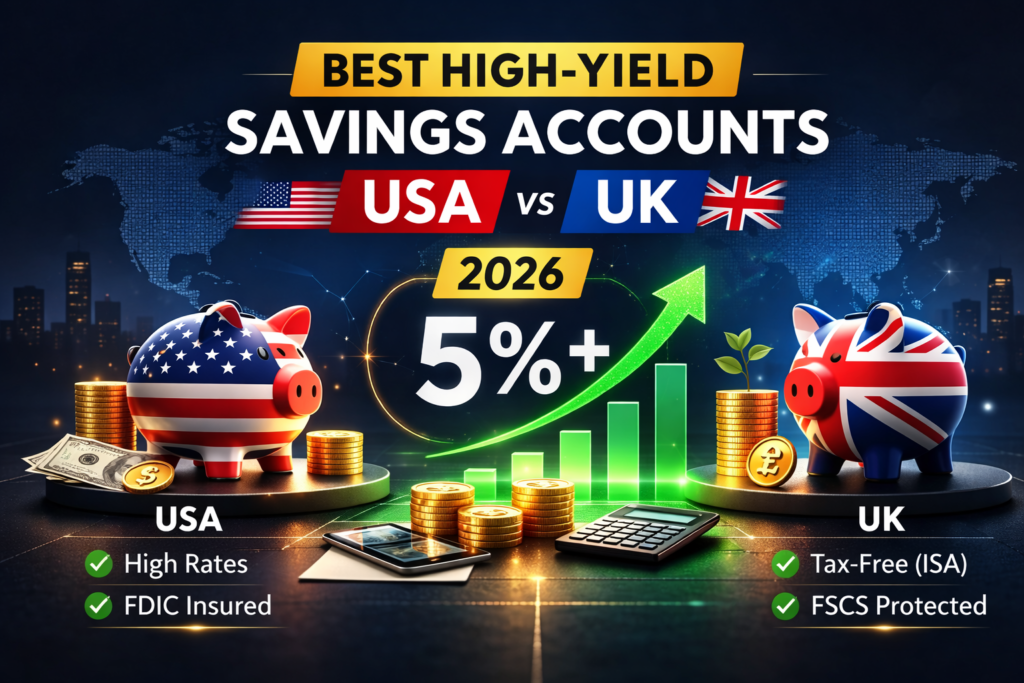
One of the strongest advantages in the US is deposit protection. Savings accounts are insured up to $250,000 per depositor, per bank, through the Federal Deposit Insurance Corporation (FDIC). This makes high-yield savings accounts extremely low risk compared to stocks or bonds.
In addition, US high yield savings accounts often feature:
- No monthly maintenance fees
- No minimum balance requirements
- Mobile-first banking apps
- Fast ACH transfers
- Automated savings tools
For American savers, the combination of strong interest rates and federal protection makes these accounts ideal for emergency funds, short-term savings goals, and capital preservation.
🇬🇧 United Kingdom: Top High yield savings accounts in 2026
In the UK, the savings landscape looks slightly different. While traditional banks remain strong, digital challengers have rapidly gained market share by offering more competitive rates and flexible access.
Some popular options in 2026 include:
UK Bank interest rates in 2026 often range between 4.00% and 5.25% on easy-access or fixed-term savings accounts, depending on the Bank of England’s monetary stance. Fixed-rate bonds may offer slightly higher yields in exchange for locking funds for 1–3 years.
Deposits in the UK are protected up to £85,000 per person, per institution, under the Financial Services Compensation Scheme (FSCS). This provides security comparable to FDIC insurance in the US.
One major advantage in the UK is the availability of Individual Savings Accounts (ISAs). Cash ISAs allow savers to earn interest tax-free within annual limits, which can significantly improve net returns for higher-rate taxpayers.
USA vs UK: Key Differences in 2026
Although both markets offer competitive yields, there are important structural differences between the two systems.
1. Taxation
In the US, savings interest is generally taxable at the federal and sometimes state level. In contrast, UK savers benefit from the Personal Savings Allowance and tax-free Cash ISAs.
2. Deposit Protection Limits
The US protects up to $250,000 per depositor, while the UK protects £85,000 per institution. Larger depositors may need to spread funds across multiple banks.
3. Account Types
The US primarily offers standard high-yield savings and money market accounts. The UK provides easy-access accounts, fixed-rate bonds, and ISAs.
4. Rate Volatility
US rates tend to respond quickly to Federal Reserve changes. UK rates follow Bank of England policy but may adjust differently depending on competition among banks.
Why High Yield Savings Accounts Matter in 2026
With global economic uncertainty, geopolitical tensions, and fluctuating stock markets, many investors are balancing growth assets with safe, interest-earning cash reserves. High yield savings accounts serve three primary purposes:
- Emergency fund storage
- Short-term savings goals (travel, home deposit, education)
- Portfolio risk management
Unlike stocks or crypto assets, savings accounts provide predictable returns. While they may not outpace long-term equity growth, they protect capital and maintain liquidity.
How to Choose the Best High-Yield Savings Account
Choosing the best account involves more than chasing the highest advertised APY. Savers should consider:
Interest Rate Stability: Some banks offer promotional rates that drop after a few months.
Fees: Always confirm there are no hidden monthly charges.
Withdrawal Flexibility: Check limits on transfers or early withdrawals.
Deposit Protection: Confirm FDIC or FSCS coverage.
Digital Experience: Mobile app quality and customer support matter.
Comparing at least three institutions before opening an account is a smart strategy.
Fixed vs Easy-Access Accounts
In both the US and UK, savers can choose between flexible accounts and fixed-term options.
Easy-access accounts allow withdrawals anytime, making them suitable for emergency funds. Fixed-term accounts usually offer higher interest but lock funds for a specific period.
If you expect interest rates to fall later in 2026, locking in a fixed rate could be advantageous. If rates are expected to rise, flexibility may be more valuable.
Risks and Considerations
While high-yield savings accounts are low risk, they are not completely immune to economic factors.
Inflation remains a concern. If inflation exceeds your interest rate, your real purchasing power declines. That’s why savings accounts are best used as part of a diversified financial strategy rather than your only investment vehicle.
Currency exposure is another factor for international readers. Holding savings in USD versus GBP may affect returns depending on exchange rate movements.
Who Should Use High-Yield Savings Accounts?
These accounts are ideal for:
- Conservative investors
- Retirees preserving capital
- First-time savers building emergency funds
- Short-term goal planners
- Investors waiting for better market entry points
They are not ideal for long-term wealth maximization alone, as equities historically outperform cash over extended periods.
Outlook for Savings Rates Beyond 2026
Interest rates in 2026 are heavily influenced by central bank policy, inflation trends, and economic growth. If inflation moderates and central banks cut rates, savings yields may decline. Conversely, persistent inflation could keep yields elevated.
For now, high-yield savings accounts remain one of the safest ways to earn steady returns without market exposure.
Final Thoughts: USA vs UK – Which Is Better?
There is no universal winner between US and UK high-yield savings accounts. Both markets offer competitive rates and strong deposit protection systems.
The US generally provides higher deposit insurance limits and a wide selection of online banks. The UK offers tax advantages through ISAs and competitive digital banking options.
The best choice depends on your residency, tax situation, savings goals, and risk tolerance. Instead of focusing solely on headline interest rates, evaluate the full financial picture—tax efficiency, access flexibility, and long-term strategy.
High-yield savings accounts in 2026 are more than just safe storage—they’re a smart financial foundation. When used correctly, they help protect capital, generate steady income, and provide flexibility during uncertain economic times.