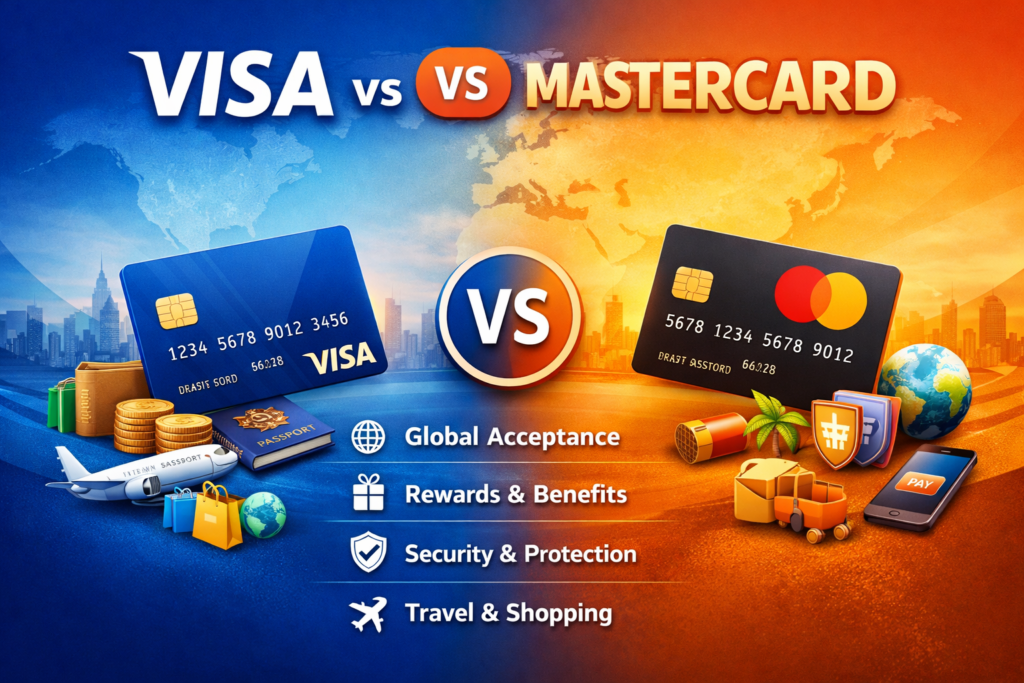
In today’s digital-first economy, debit and credit cards have become an essential part of everyday life. From online shopping and bill payments to international travel and contactless transactions, cards make payments fast, secure, and convenient. Among all card networks, Visa vs Mastercard stand out as the two most dominant players in the global payments industry.
Although consumers often debate which is “better,” the truth is more nuanced. Visa and Mastercard are not banks, and they do not issue cards directly. Instead, they operate payment networks that connect merchants, banks, and customers. This article provides a detailed, unbiased comparison of Visa vs Mastercard, helping you understand how they work, how they differ, and which one may suit your needs better.
Understanding How Card Networks Work
Before comparing Visa and Mastercard, it’s important to understand their role in the payment ecosystem. When you swipe or tap a card, several parties are involved:
- The cardholder (you)
- The issuing bank (your bank)
- The merchant
- The merchant’s acquiring bank
- The payment network (Visa or Mastercard)
Visa and Mastercard act as intermediaries that securely route transaction data and ensure payments are authorized and settled. They set technical standards, manage fraud prevention systems, and enable global acceptance.
Global Presence and Market Reach
Visa’s Global Footprint
Visa is the largest card network in the world in terms of transaction volume. It operates in more than 200 countries and territories and processes trillions of dollars in payments annually. Due to its early expansion strategy, Visa enjoys extremely wide acceptance, especially in the United States and many developing markets.
Mastercard’s Global Footprint
Mastercard operates in a similar number of countries and territories and is accepted at millions of merchant locations worldwide. While slightly smaller in transaction volume compared to Visa, Mastercard has focused heavily on innovation, digital payments, and emerging markets.
Bottom line: In practical terms, both networks are accepted almost everywhere. Finding a place that accepts Visa but not Mastercard—or vice versa—is rare.
Card Types and Product Offerings
Both networks offer a wide range of card categories designed for different customer needs.
Visa Card Types
- Visa Classic
- Visa Gold
- Visa Platinum
- Visa Signature
- Visa Infinite
Mastercard Card Types
- Mastercard Standard
- Mastercard Gold
- Mastercard Platinum
- World Mastercard
- World Elite Mastercard
The card type determines benefits such as reward points, insurance coverage, concierge services, and spending limits. However, the issuing bank ultimately decides the exact benefits, not the network itself.
Fees and Costs: Is One Cheaper?
A common misconception is that Visa or Mastercard charges customers directly. In reality:
- Annual fees are set by issuing banks.
- Interest rates depend on the bank and card type.
- Foreign transaction fees are usually charged by the bank, not the network.
That said, Visa and Mastercard do charge interchange and network processing fees to banks and merchants. These fees are very similar between the two networks, meaning there is usually no noticeable cost difference for consumers.
Key takeaway: Cost differences are driven more by your bank than by whether your card is Visa or Mastercard.
Rewards, Cashback, and Offers
Rewards programs are one of the biggest reasons people choose certain cards. Both Visa and Mastercard support:
- Cashback programs
- Travel reward points
- Airline miles
- Dining and shopping discounts
Visa Offers
Visa often partners with international brands, hotels, and airlines to provide global discounts and seasonal promotions. Visa Signature and Infinite cards are particularly strong in travel-related perks.
Mastercard Offers
Mastercard focuses heavily on lifestyle benefits such as dining experiences, entertainment access, and exclusive events. World and World Elite Mastercard holders often receive premium privileges.
Again, most rewards are designed by issuing banks, but network-level perks can add extra value.
Security and Fraud Protection
Security is a critical factor when comparing Visa and Mastercard. Fortunately, both networks invest heavily in advanced security technologies.
Shared Security Features
- EMV chip technology
- Contactless payments
- Tokenization for digital wallets
- Real-time fraud monitoring
- Zero liability protection for unauthorized transactions
Visa Security Tools
Visa uses artificial intelligence and machine learning to analyze billions of transactions in real time, helping detect suspicious activity instantly.
Mastercard Security Tools
Mastercard also uses AI-based fraud detection and offers strong identity verification systems, particularly for online transactions.
Verdict: Both are equally secure for everyday use.
International Travel and Currency Conversion
For frequent travelers, international usability is a major concern.
- Both Visa and Mastercard are widely accepted globally.
- Exchange rates are usually very close, with minor daily differences.
- Some banks charge foreign transaction fees regardless of the network.
In some regions, such as parts of Europe, Mastercard may be slightly more common, while in the US and Asia, Visa often has marginally wider acceptance. However, the difference is rarely significant.
Digital Wallets and Online Payments
Visa and Mastercard both support modern digital payment systems, including:
- Apple Pay
- Google Pay
- Samsung Pay
- Online subscription services
- E-commerce platforms
Both networks also support one-click checkout systems and enhanced online authentication, making digital payments smoother and safer.
Business and Corporate Cards
For businesses, Visa and Mastercard offer specialized solutions:
Visa Business Solutions
- Corporate credit cards
- Travel and expense management
- Cross-border payment tools
Mastercard Business Solutions
- Business and purchasing cards
- Data analytics tools
- Expense tracking integrations
Small businesses and large enterprises can benefit from either network, depending on bank partnerships and regional availability.
Acceptance in India and Emerging Markets
In countries like India, Visa and Mastercard are both widely used for:
- Debit cards linked to savings accounts
- Online shopping
- International transactions
- ATM withdrawals
Regulatory changes and domestic payment systems have increased competition, but Visa vs Mastercard remain important for international payments and cross-border commerce.
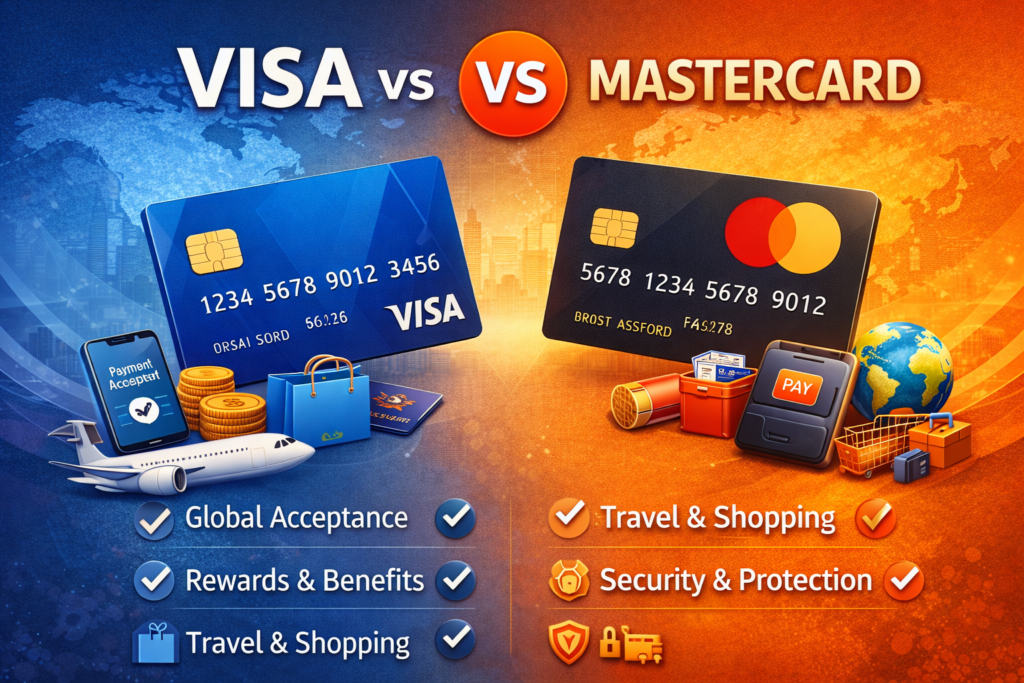
Visa vs Mastercard: Key Differences at a Glance
| Feature | Visa | Mastercard |
|---|---|---|
| Global acceptance | Very high | Very high |
| Transaction volume | Slightly higher | Slightly lower |
| Security | Excellent | Excellent |
| Rewards focus | Travel & global perks | Lifestyle & experiences |
| Fees | Bank-dependent | Bank-dependent |
Which One Should You Choose?
The honest answer is: choose the card based on the bank and benefits, not just the network.
Visa and Mastercard are more similar than different. Factors that matter more include:
- Interest rate
- Annual fee
- Rewards structure
- Customer service of the issuing bank
- Additional benefits like insurance or lounge access
If you already have a Visa vs Mastercard, you are unlikely to face limitations purely because of the network.
Final Thoughts
Visa and Mastercard are the backbone of the modern global payment system. They power billions of transactions every day, enabling secure, fast, and reliable payments across borders and platforms. While minor differences exist in branding, partnerships, and premium benefits, both networks deliver exceptional performance.
For consumers, the smartest approach is to compare individual card offers rather than focusing solely on whether the card says Visa vs Mastercard. When chosen wisely, either option can be a powerful financial tool for everyday spending, travel, and long-term financial management.