
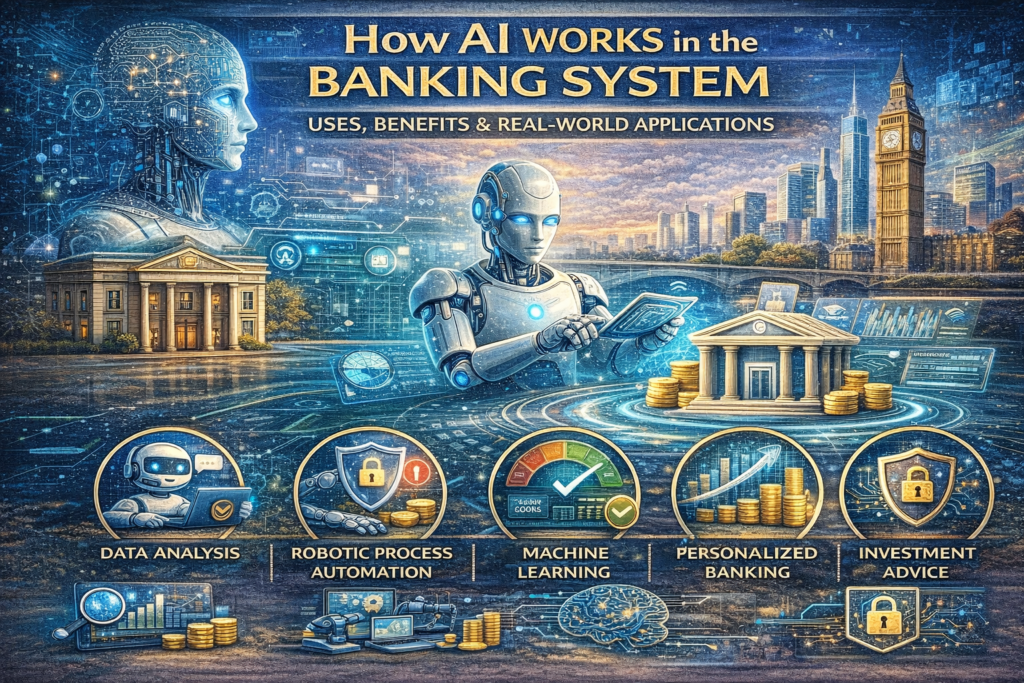
Artificial Intelligence (AI) is transforming the banking system across the world. From mobile banking apps and fraud detection to customer service chatbots and credit scoring, AI has become an essential part of modern banking operations. Banks handle massive amounts of data every day, and AI helps analyze this data quickly, accurately, and efficiently. In today’s digital era, customers expect fast service, personalized experiences, and secure transactions. AI enables banks to meet these expectations while reducing operational costs and improving decision-making. Understanding how AI works in the banking system helps customers, businesses, and policymakers appreciate its impact on financial services.
This article explains how AI works in banking, where it is used, its benefits, challenges, and future potential, in a simple and beginner-friendly manner.
What Is Artificial Intelligence (AI) in Banking?
Artificial Intelligence refers to computer systems that can perform tasks that normally require human intelligence. In banking, AI systems learn from data, recognize patterns, and make decisions or predictions with minimal human intervention.
AI in banking commonly uses technologies such as:
- Machine learning
- Natural language processing
- Data analytics
- Automation tools
These technologies allow banks to operate faster, smarter, and more securely.
Why Banks Use AI
Banks deal with millions of transactions and customer interactions daily. AI helps banks manage this complexity.
Key Reasons Banks Use AI
- Faster data processing
- Improved customer experience
- Better risk management
- Fraud prevention
- Cost reduction
AI enables banks to offer reliable services while maintaining high security standards.
How AI Works in the Banking System
AI systems in banking work by analyzing large datasets and learning from past information.
Basic Working Process
- Banks collect customer and transaction data
- AI algorithms analyze patterns and trends
- Systems learn from historical data
- AI makes predictions or recommendations
- Decisions are improved over time through learning
This continuous learning process makes AI systems more accurate and efficient.
AI in Customer Service
One of the most visible uses of AI in banking is customer support.
Chatbots and Virtual Assistants
AI-powered chatbots answer customer queries instantly.
Common Tasks
- Balance inquiries
- Transaction history
- Card blocking
- Loan and account information
Chatbots work 24/7 and reduce the need for human support staff.
AI in Fraud Detection
Fraud detection is one of the most critical applications of AI in banking.
How AI Detects Fraud
- Monitors transactions in real time
- Identifies unusual behavior
- Compares with historical patterns
- Flags suspicious activities
AI systems can detect fraud faster than traditional methods, reducing financial losses.
AI in Credit Scoring and Loan Approval
AI plays a major role in evaluating loan applications.
Traditional vs AI-Based Credit Assessment
Traditional systems rely mainly on credit scores, while AI considers multiple factors.
AI Analyzes
- Income patterns
- Spending behavior
- Repayment history
- Employment stability
This leads to more accurate and fair credit decisions.
AI in Risk Management
Banks face various risks, including credit risk, market risk, and operational risk.
Role of AI in Risk Management
- Predicts potential defaults
- Assesses market trends
- Helps banks prepare for economic changes
AI improves decision-making and strengthens financial stability.
AI in Personalized Banking
AI allows banks to offer personalized services.
Examples
- Customized product recommendations
- Personalized savings plans
- Tailored investment suggestions
By analyzing customer behavior, how AI works in the banking system helps banks understand individual needs better.
AI in Transaction Monitoring
AI continuously monitors banking transactions.
Benefits
- Faster transaction processing
- Reduced errors
- Improved compliance
Transaction monitoring ensures secure and smooth banking operations.
AI in Compliance and Regulation
Banks must follow strict regulations. how AI works in the banking system- AI helps automate compliance tasks.
AI Helps With
- Monitoring regulatory requirements
- Identifying compliance risks
- Automating reporting processes
This reduces manual work and improves accuracy.
AI in Wealth Management
AI is increasingly used in investment and wealth management services.
Key Functions
- Portfolio analysis
- Risk assessment
- Automated investment advice
AI-powered tools help customers make informed financial decisions.
AI in Branchless and Digital Banking
Digital banking relies heavily on AI technologies.
Features Enabled by AI
- Mobile banking apps
- Voice-based banking
- Facial and fingerprint authentication
AI improves convenience while maintaining security.
Benefits of AI in the Banking System
AI offers several advantages to banks and customers.
Key Benefits
- Faster service delivery
- Reduced operational costs
- Improved accuracy
- Enhanced security
- Better customer experience
These benefits make banking more efficient and accessible.
Challenges of AI in Banking
Despite its advantages, AI adoption comes with challenges.
Key Challenges
- Data privacy concerns
- Cybersecurity risks
- High implementation costs
- Need for skilled professionals
Banks must address these challenges carefully.
Ethical and Privacy Concerns
AI systems rely on customer data, which raises privacy concerns.
Important Considerations
- Data protection
- Transparency in decision-making
- Avoiding bias in algorithms
Responsible AI use is essential to maintain customer trust.
AI vs Human Role in Banking
AI does not replace humans entirely.
Human Role
- Strategic decision-making
- Relationship management
- Handling complex cases
AI supports humans rather than replacing them.
Future of AI in Banking
AI adoption in banking is expected to grow further.
Future Trends
- Advanced predictive analytics
- Voice and biometric banking
- Smarter fraud prevention
- Fully automated banking processes
AI will continue to reshape the banking industry.
Impact of AI on Customers
Customers benefit significantly from AI-driven banking.
Customer Advantages
- Faster service
- Personalized solutions
- Improved security
- Better financial insights
AI enhances overall banking experience.
AI and Financial Inclusion
AI helps expand banking access.
How AI Supports Inclusion
- Faster account opening
- Alternative credit assessments
- Digital banking in remote areas
This supports inclusive economic growth.
Frequently Asked Questions (FAQs)
Is AI safe to use in banking?
Yes, when properly regulated and secured.
Does AI replace bank employees?
No, AI supports employees by automating routine tasks.
Is AI used in mobile banking apps?
Yes, AI powers chatbots, fraud alerts, and personalization.
Can AI make banking decisions?
AI assists decisions, but final approval often involves human oversight.
Conclusion
Artificial Intelligence has become a powerful force in the banking system. By analyzing data, detecting fraud, improving customer service, and supporting decision-making, AI has transformed how banks operate. how AI works in the banking system, It enables faster, safer, and more personalized financial services while reducing operational costs.
Although challenges such as data privacy and ethical concerns remain, responsible implementation of AI can strengthen trust and efficiency in banking. how AI works in the banking system, As technology continues to evolve, AI will play an even bigger role in shaping the future of the global banking system.
Disclaimer
This article is for informational and educational purposes only. AI applications and banking technologies may vary by institution and region.