
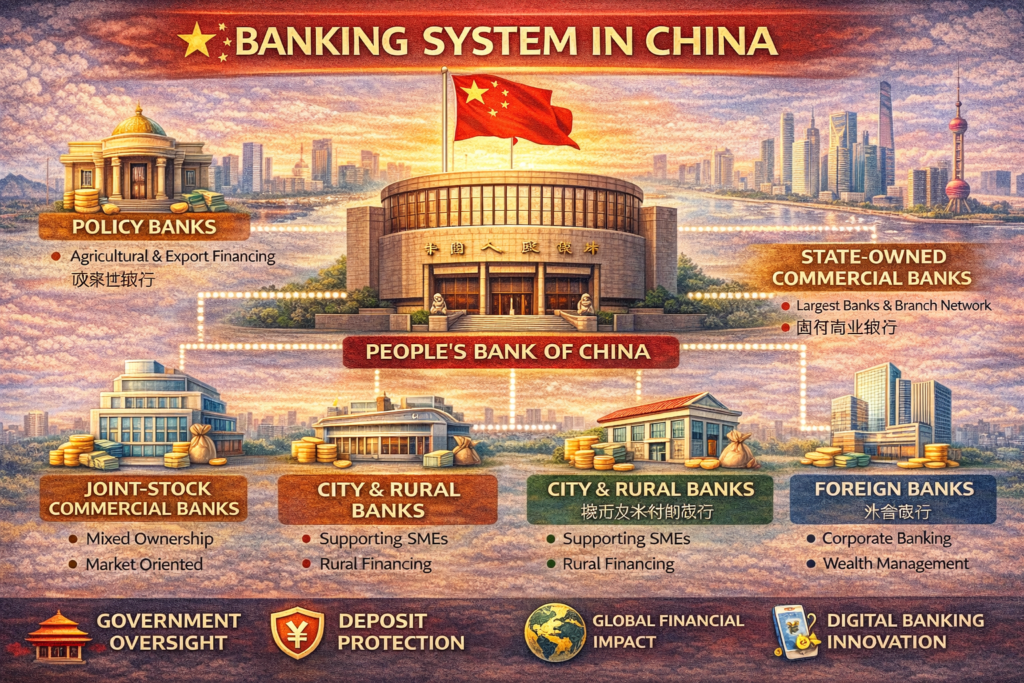
China has one of the largest and most influential banking systems in the world. As the second-largest economy globally, China’s financial system plays a crucial role in domestic economic growth, international trade, and global finance. The Chinese banking system is known for its strong government involvement, large state-owned banks, and rapidly expanding digital banking infrastructure. Unlike banking system in china that are dominated by private institutions, China’s banking sector is largely led by state-owned commercial banks, supported by joint-stock banks, policy banks, and rural financial institutions. This structure allows the government to guide economic development while maintaining financial stability.
This article explains the banking system in China, its structure, types of banks, regulatory framework, and its importance to the Chinese economy.
Overview of the Banking System in China
China’s banking system is a state-led but market-oriented financial system. It supports individuals, businesses, and large infrastructure projects while aligning closely with national economic policies.
Key characteristics include:
- Strong government oversight
- Dominance of large state-owned banks
- Rapid digital and mobile banking growth
- Expanding global financial presence
The system balances economic control with gradual financial reforms.
Importance of the Banking System in China
The banking system is central to China’s economic model because it:
- Finances infrastructure and industrial growth
- Supports exports and international trade
- Mobilizes household savings
- Provides credit to businesses and government projects
- Maintains financial stability
Banks act as a major channel through which economic policies are implemented.
Structure of the Banking System in China
China’s banking system consists of several categories of financial institutions:
- Central Bank
- Policy Banks
- State-Owned Commercial Banks
- Joint-Stock Commercial Banks
- City and Rural Banks
- Foreign Banks
Each plays a distinct role in the financial ecosystem.
Role of the Central Bank: People’s Bank of China (PBOC)
The People’s Bank of China (PBOC) is the central bank of China.
Key Functions
- Formulating and implementing monetary policy
- Issuing currency (Renminbi / Yuan)
- Regulating money supply and interest rates
- Managing foreign exchange reserves
- Maintaining financial stability
The PBOC works closely with the government to support economic goals.
Policy Banks in China
Policy banks are state-owned institutions created to support government development objectives rather than profit.
Main Policy Banks
- Agricultural Development Bank of China
- China Development Bank
- Export-Import Bank of China
Key Roles
- Infrastructure financing
- Agricultural support
- Export and trade financing
Policy banks play a strategic role in long-term economic development.
State-Owned Commercial Banks
State-owned commercial banks are the backbone of China’s banking system.
Key Characteristics
- Majority government ownership
- Nationwide branch networks
- Large customer base
Services Provided
- Savings and current accounts
- Personal and business loans
- Mortgages
- Trade finance
These banks serve both individuals and large enterprises.
Joint-Stock Commercial Banks
Joint-stock banks operate with mixed ownership, including government and private shareholders.
Features
- More market-oriented operations
- Competitive products and services
- Strong presence in urban areas
They bridge the gap between state control and market efficiency.
City Commercial Banks
City commercial banks focus on local and regional financial needs.
Role
- Support small and medium-sized enterprises (SMEs)
- Provide retail banking services
- Promote regional economic development
They contribute to financial inclusion at the local level.
Rural Financial Institutions
Rural banks and credit cooperatives support agricultural and rural communities.
Services Include
- Agricultural loans
- Rural savings accounts
- Small business financing
These institutions help reduce the urban-rural financial gap.
Foreign Banks in China
China allows foreign banks to operate under regulatory approval.
Activities
- Corporate banking
- Trade finance
- Wealth management
Foreign banks contribute to competition and financial expertise.
Regulation and Supervision of Banks
China has a strong regulatory framework to ensure stability.
Regulatory Authorities
- People’s Bank of China (PBOC)
- Banking and insurance regulatory bodies
- Government financial agencies
Regulation focuses on:
- Capital adequacy
- Risk control
- Consumer protection
- Financial stability
Deposit Protection in China
China has a deposit protection system to safeguard depositors.
Key Points
- Covers eligible bank deposits up to a specified limit
- Applies to most banking institutions
- Enhances public confidence
Deposit insurance strengthens trust in the banking system.
Digital Banking and Fintech in China
China is a global leader in digital banking and financial technology.
Key Developments
- Mobile payments
- Online banking platforms
- Digital wallets
- QR-code based transactions
Digital banking has transformed daily financial activities in China.
Role of Banks in China’s Economic Development
Banks support China’s growth by:
- Financing infrastructure projects
- Supporting manufacturing and exports
- Providing credit to SMEs
- Enabling urbanization and development
Banking is closely linked to national economic planning.
Challenges Facing the Banking System in China
Despite its size, the system faces challenges.
Key Challenges
- Managing non-performing loans
- Balancing growth and risk
- Regulatory compliance
- Financial transparency
Reforms continue to address these challenges.
Advantages of the Chinese Banking System
- Strong government backing
- Large capital base
- Extensive branch network
- Advanced digital banking
These strengths contribute to resilience and growth.
Banking System in China vs Other Countries
Compared to many countries, China’s banking system is:
- More state-controlled
- Policy-driven
- Rapidly digitized
This model supports large-scale economic planning.
Importance of Financial Inclusion
Financial inclusion is a key focus of China’s banking system.
Benefits
- Access to banking in rural areas
- Support for small businesses
- Reduced reliance on cash
Banks and fintech firms work together to expand access.
Frequently Asked Questions (FAQs)
Who regulates banks in China?
Banks are regulated by the People’s Bank of China and related authorities.
Are Chinese banks state-owned?
Many major banks are majority state-owned, though private participation exists.
Is digital banking popular in China?
Yes, China is a global leader in digital payments and online banking.
Are deposits safe in China?
Eligible deposits are protected under a deposit insurance system.
Conclusion
The banking system in China is one of the largest, most influential, and rapidly evolving financial systems in the world. With strong government oversight, large state-owned banks, and advanced digital banking infrastructure, it plays a central role in supporting China’s economic growth and global trade. While challenges remain, ongoing reforms and technological innovation continue to strengthen the system.
Understanding how the Chinese banking system works provides valuable insight into China’s economic model and its role in global finance.
Disclaimer
This article is for informational and educational purposes only. Banking regulations and services in China may change over time. Always refer to official regulatory sources for current information.