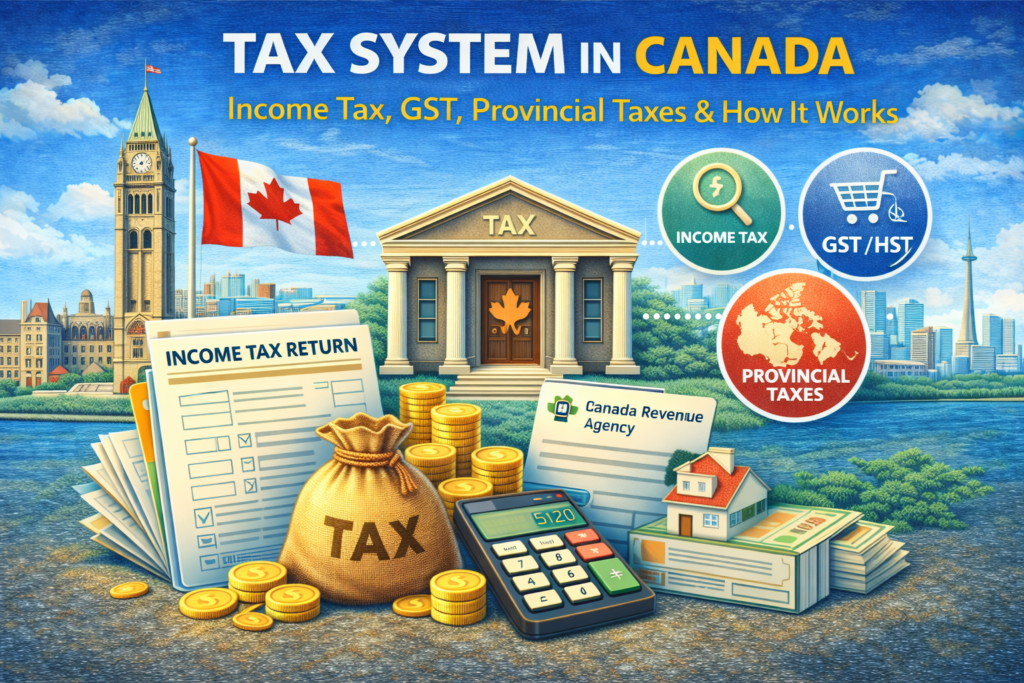
The tax system in Canada plays a vital role in supporting the country’s public services and economic stability. Taxes collected by federal, provincial, and local governments fund healthcare, education, infrastructure, social security programs, public transportation, and other essential services. Canada follows a structured and transparent tax framework that balances fairness with economic growth.
Unlike some countries where taxation is managed mainly at the national level, Canada uses a multi-level tax system. Individuals and businesses may be required to pay taxes to the federal government, provincial or territorial governments, and sometimes local authorities. Understanding how the Canadian tax system works helps residents, newcomers, and businesses stay compliant and financially prepared.
This article explains the tax system in Canada in a simple and beginner-friendly way, covering income tax, GST/HST, provincial taxes, and how taxes are collected. tax system in Canada
Overview of the Canadian Tax System
Canada’s tax system operates at three main levels:
- Federal government
- Provincial and territorial governments
- Local governments (mainly municipalities)
Each level has its own responsibilities and authority to collect certain types of taxes. The system is designed to ensure that revenue is distributed efficiently to meet public needs across the country.
Why Taxes Are Collected in Canada
Taxes are collected in Canada to:
- Fund universal healthcare
- Support education and public schools
- Build and maintain roads, bridges, and transit systems
- Provide social programs and pensions
- Ensure public safety and national defense
Tax revenue allows governments to provide a high standard of living and social support to residents.
Federal Taxes in Canada
Federal Income Tax
Federal income tax is one of the main sources of government revenue in Canada.
Key Features
- Paid by individuals on income earned during the year
- Uses a progressive tax system
- Higher income earners pay higher tax rates
- Calculated annually through tax returns
Income sources include employment income, business income, and certain investment earnings.
Corporate Income Tax
Corporations operating in Canada pay corporate income tax on their profits.
Key points:
- Applies to Canadian and foreign companies with Canadian operations
- Separate from personal income tax
- Important source of federal revenue, tax system in Canada
Provincial and Territorial Taxes
Each province and territory in Canada has the authority to impose its own taxes.
Provincial Income Tax
Most provinces and territories charge income tax in addition to federal income tax.
- Rates vary by province
- Some provinces use a progressive system
- Collected together with federal tax in many cases
Although collected through a single tax return, federal and provincial taxes are calculated separately.
Provincial Sales Taxes
Sales taxes in Canada vary by province.
Common Types
- GST (Goods and Services Tax) – federal
- PST (Provincial Sales Tax) – provincial
- HST (Harmonized Sales Tax) – combined federal and provincial
Some provinces use GST + PST, while others use HST.
Goods and Services Tax (GST)
GST is a federal consumption tax applied to most goods and services in Canada.
Key Features of GST
- Charged at the point of sale
- Paid by consumers
- Collected by businesses and remitted to the government
Certain essential items may be zero-rated or exempt from GST.
Harmonized Sales Tax (HST)
HST combines federal GST and provincial sales tax into a single tax.
Benefits of HST
- Simplifies tax collection
- Reduces administrative burden
- Creates a uniform system
HST rates vary depending on the province.
Other Important Taxes in Canada
Payroll Taxes
Payroll taxes support social programs such as:
- Canada Pension Plan (CPP)
- Employment Insurance (EI)
Both employees and employers contribute.
Property Tax
Property tax is collected by local governments.
Purpose
- Funds local services such as schools, fire departments, and waste management
- Based on property value
Property tax rates vary by municipality.
Excise Taxes
Excise taxes apply to specific goods such as:
- Fuel
- Alcohol
- Tobacco
These taxes generate revenue and influence consumption behavior.
How Taxes Are Collected in Canada
Tax Identification
Individuals use a Social Insurance Number (SIN) for tax purposes. Businesses register for business numbers.
Filing Tax Returns
Most individuals must file an annual income tax return.
Returns can be filed:
- Online using certified software
- By mail
- Through authorized tax professionals
The tax year runs from January 1 to December 31.
Payment and Refunds
After assessment:
- Taxpayers may need to pay additional tax
- Or receive a refund if excess tax was paid
Timely filing helps avoid penalties and interest.
Role of the Canada Revenue Agency (CRA)
The Canada Revenue Agency (CRA) manages Canada’s tax system.
Responsibilities of the CRA
- Collecting federal and provincial taxes
- Administering tax laws
- Processing tax returns
- Conducting audits
- Providing taxpayer support
The CRA ensures fairness and compliance across the system.
Digital Tax Filing in Canada
Canada has a modern and digital tax filing system.
Benefits
- Faster processing
- Reduced paperwork
- Secure electronic filing
- Quick refunds
Most Canadians now file their taxes online.
How Tax Revenue Is Used in Canada
Tax revenue supports:
- Universal healthcare
- Education and research
- Infrastructure projects
- Social welfare programs
- Environmental initiatives
Public spending helps maintain Canada’s quality of life.
Challenges in the Canadian Tax System
Despite its strengths, the tax system faces challenges:
- Complexity for new residents
- Differences between provinces
- Compliance for small businesses
- Tax avoidance concerns
Governments continue to improve clarity and accessibility.
Importance of Understanding the Canadian Tax System
Understanding how taxes work helps individuals:
- Meet legal obligations
- Avoid penalties
- Plan finances better
- Access benefits and credits
Tax awareness is an important part of financial literacy.
Frequently Asked Questions (FAQs)
Do all Canadians pay income tax?
Most residents earning above a basic threshold are required to pay income tax.
Is GST charged everywhere in Canada?
Yes, but some provinces use HST instead of separate GST and PST.
Do provinces have different tax rates?
Yes, provincial tax rates and sales taxes vary.
Is online tax filing mandatory?
No, but it is the most common and convenient method.
Conclusion
The tax system in Canada is a structured and multi-level framework designed to fund public services and support economic growth. With federal, provincial, and local taxes working together, the system ensures stable revenue while promoting fairness and transparency. Digital tax filing and centralized administration through the CRA have made compliance easier for taxpayers. tax system in Canada
By understanding how the Canadian tax system works, individuals and businesses can better manage their responsibilities and contribute to the country’s long-term development.
Disclaimer
This article is for informational and educational purposes only. Tax laws and rates may change over time and vary by province. Always refer to official government sources or the Canada Revenue Agency for the latest information.